Showing posts with label film. Show all posts

Wednesday, July 21, 2010

Watch "Water on the Table"

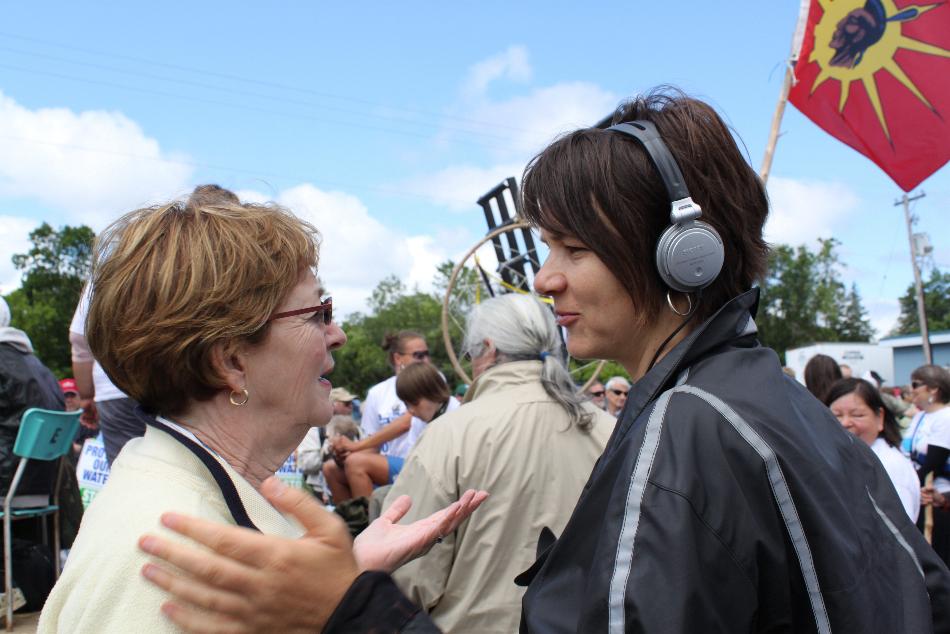
Filmmakers Maude Barlow and Liz Marshall talk during the filming of "Water on the Table." (Click on the picture for original photo source)

Have you seen Water on the Table?? It is a film by Liz Marshall and Maude Barlow, about the humanity of water. I first heard about it when it was featured in one of my college auditoriums at Lake Forest College in the US. Along with promoting this documentary, the book Blue Gold written by Barlow and Tony Clarke, was also promoted. It is claimed that film director, Liz Marshall, was truly inspired by the book and had decided on bringing a visual aspect to pass on the message.


The message was simple-“water is a human right and not a commodity to be bought and sold like oil and sugar.” This documentary is both beautiful and poetic, as well as controversial and thought provoking.

If you have not seen it, I would strongly recommend doing so.

More links:
Water on the Table main website: http://www.wateronthetable.com/
You can also follow them on twitter: @wateronthetable

------
This is the first in a series of posts by KS, an intern who is working with me over the summer.

Thursday, October 8, 2009

Truth, shame, and education


If the truth sets you free, then why do people hide behind the shame of it all?? (photo: Osvaldo Zoom)

A couple of days ago, I blogged about I Am Because We Are. It very interestingly juxtaposed with something else I saw a while ago...a critically acclaimed film called The Education of Shelby Knox on PBS.

One might wonder how I Am Because We Are, a film about orphans in Malawi, relates to a film about a kid growing up in Lubbock, TX...but its quite clear. It doesn't matter where you are, the truth seems to scare people. And further, shame is a powerful motivator.

The increasing rate of orphans in Malawi is from the increasing rate of AIDS in the country. And what is universally acknowledged as the biggest problem is the lack of openness of the issues of HIV/AIDS in their communities. Government and Community leaders are refusing to speak about the issue openly. The lack of knowledge and wisdom, and the consistent shame value placed on AIDS is perpetuating the situation. In the absence of good sensible leadership, the frustrated, largely uneducated masses are getting more and more desperate. This is leading them to even more risky behaviors -- raping virgin girls, "sexual cleansing" of AIDS widows, and every kind of nonsense witchcraft that is sinking them deeper with infection and poverty.

On the other side of the globe, in Lubbock, TX, the rate of teen pregnancy has sky-rocketed. The conservative school and town leadership are refusing to speak openly about the issue, instead pushing abstinence down the throats of their youngsters...who defy all odds and continue to reproduce at alarming rates. This is where Shelby Knox (and her truly amazing family) come into the picture; Shelby, herself a 15 y/o conservative Christian pledged to abstinence until marriage, is trying to understand what the best way is to address this problem amongst her peers. Over three years the film follows her as she lobbies and repeatedly fails to get sex education taught to young kids. In the meantime,

And so here, the two sides of the globe (and lots of places in between) are united by the shame of speaking openly about sexual issues. How is the abysmal leadership of Malawi (second poorest country in the world) any different from that of Lubbock, TX (situated in one of the richest countries in the world)?? Why is it so hard to speak the truth...even if it does set you free??

I am struggling to understand this bit. Why NOT do the sensible thing?? And how do you fix this??

Monday, October 5, 2009

Ubuntu: I am Because WE are


I Am Because We Are. Watch it!! (photo credit: http://blog.photoshelter.com)

I saw a beautiful documentary film today called I Am Because We Are (entire film is available below).

I had heard about it in the Spring, even gone to the official launch party in NYC. But it was made and backed by Madonna, and in the age of haute celebrity endorsements, I have become skeptical of their attention to something. How much do they really know? How much do they really care?? How long will their attention last?? Long after the cool is gone, will they still be around??

Today, in search of inspiration, I picked it up. I am glad I did.

I Am Because We Are claims to be a look at Malawi, but its really a more universal story of poverty in the developing world. The film looks at the bigger picture, examining a smaller problem (the increasing number of orphans) against the larger backdrop of economic development (where the orphaning is coming from and how it affects global poverty). There is an interconnectedness to their theory that I so believe in-- examining the history, the need for responsibility, the lack of leadership, a variety of indigenous perspectives, the positives, the negatives...its all in there. Alongside the development porn, there is an equal showcasing of the laughter, community, and resilient spirit of the locals. There are perspectives of kids, adults, Malawians, Africans, and international people with a vested interest in the country or region. The opinions are educated. It is REFRESHING to hear Malawians analyze their own country's situation in a most educated manner examining causes and effects, and solutions, rather than the typical western viewpoints. Its wonderful to hear Africans speak about their continent in an intelligent manner. I GREATLY appreciated this. The West, doesn't have all the answers. Each country needs to come up with its own.

The title comes from the Zulu word "Ubuntu" meaning "I am because we are." Think about it!! I can't think of a better term to showcase our interconnectedness.

Good News. I learned that you can watch the entire film for FREE on YouTube. Check it out here on YouTube and below (NOTE: I recommend watching it on the YouTube site. Its much faster and you get the larger, widescreen version!)

Wednesday, July 15, 2009

The Pixar Story


photo source: solarnavigator.net

Pixar is pure magic and genius. It is the Walt Disney Company for the 21st century.

I've been reading the Pixar Touch (which I highly recommend) that gives the whole story of a group of visionaries whose visions were nearly killed several times. This lecture/panel discussion with the founders and main leaders in Pixar gives a great behind-the-scenes look at what makes the Studios tick, and what their recipe for success is (hint: people, people, people).

Wednesday, June 24, 2009

One in 8 Million photoproject


The visually stunning One in 8 Million photo project (photosource: NYTimes)

Thanks to a friend (hat-tip GK), I came across this visually stunning photoproject, called One in 8 Million, that highlights the interesting lives of everyday people in New York City...like an 80 y/o tabloid photographer, a young female pathologist who has been performing autopsies at one of NYC's busiest hospitals, a 72 y/o accountant who works by night rather than the day, a chinese woman who adopted an ethiopian child, a teenage mom who was changed by the experience, etc.

Definitely check it out...

Thursday, June 11, 2009

Two sides of a story: Learning about the death penalty


Reverend Carroll Pickett, a prison chaplain who presided over several executions, reflects on his role in and thoughts on the Death Penalty. Pickett is profiled in the film At the Death House Door, which forced me reexamine longheld views on the issue (photo source: NY Sun).

I always make a case for education being a lifelong commitment. For me, education doesn't stop with a diploma of whatever sort from an institution; it is only the beginning. Issues and people are living things; and as long as they are living, they are changing; and that means that you need to constantly read up and educate yourself about an issue.

I was reminded again of this recently, when I watched a documentary about the death penalty. I have always believed in the death penalty. If you killed, then you deserved to be killed in return; the point being that it was only fair, and would act as a deterrent to others. Then I watched a documentary called At the Death House Door, that profiles the life of a prison chaplain who has had to preside over executions. It REALLY forced me to rethink my views on the death penalty.

Father Carroll Pickett is a man of great faith, who had personally witnessed friends being murdered, comforted their families during their funerals, and later had to pray with the man who had murdered them. He is a person who had believed strongly in the death penalty, but after spending years as a prison chaplain and presiding over several executions, has experienced a change of heart. It is a poignant, humane, and moving portrait of a man of great strength and faith, pushed to his limits; then finding peace and strength in his family.

Regardless of which side you stand on, it is a fascinating look inside the life of an ordinary man with an extraordinary role. Here's a preview (not a huge fan of the trailer...the film is FAR more softly and beautifully done than the trailer indicates):


On this subject, also check out one of the chapters in Atul Gawande's book Better, that profiles the ethical dilemmas of medical practitioners who preside over executions. Another write up that really forces you to think deeper about this issue.

Monday, May 11, 2009

Gateway to Hollywood


Ashok Amritraj on "Gateway to Hollywood" (photo source: http://pixtelevision.com/pix_gateway/images/gateway_home_top.jpg)

Somehow, I came across and got hooked onto this Indian reality show about filmmakers. Its called "Gateway to Hollywood," and it is a bit like "The Apprentice" for young, amateur filmmakers. The show brings together 18 talented filmmakers from across India and over the course of 16 weeks of challenges, picks the best to direct a film in Hollywood...a dream for any filmmaker!

The show is run by former Indian tennis-pro, now turned Hollywood film producer, Ashok Amritraj, who is eager to give young, talented filmmakers the chance he never had. While the show is poorly produced, the quality of the filmmakers, their tasks, and output were really solid. So good infact that I sat up for two nights in a row and watched the episodes back-to-back.

I love the idea of ex-pats returning to their countries to help their own develop. I honestly think that the health of a developing country's economy depends on the health of their ex-pat community. Look at India, China, Korea, and Mexico. There are many more examples where these come from; but an ex-pat's strong cultural ties, tenacity, intelligence, lessons learned along the way, coupled with the west's business practices of efficiency and ethics, makes him/her a force to contend with.

Unfortunately, Gateway episodes are archived on the horrible rediff ishare platform (as opposed to the infinitely smoother and more reliable hulu, youtube, or vimeo sites), so I've had numerous problems with viewing them. Still I would encourage a view.

I was blown away and heartily encouraged by the latent talent in India; I'm sure every other developing country has this level of talent just hanging out waiting to be discovered!

Here's a part of the first episode:

Monday, April 27, 2009

The Damned Rain


In Gabricha Paus ("The Damned Rain") above, Satish Manwar and Prashant Pethe show the stress on farmers in India; below, the farmer's mother and wife discuss how to raise the spirits of their depressed husband.

Last week, I ventured over to the Indian Film Festival, taking place in Los Angeles. I have been hunting for Indian independent film anywhere and it is SO hard finding any...ironically, more so in India!

(On a separate note, I'm embarrassed to say that the piracy rates are awful in the US. The Indian merchants locally are just unethical bastards...they will make money at any cost. Quite often they shamelessly make money on pirated versions of DVD's, renting out bad quality stuff that they illegally download and charge you an arm-and-a-leg for!! I don't think I mind so much with the big masala flicks...I hate it when they do it to small, struggling independent producers...)

So it was a pleasant surprise to come across some genuinely good and well-intentioned filmmakers at the Festival. The films have been sold out, indicating a demand for such type of films in the US, but it made it very hard for me to see anything. And I can't seem to figure out where I can find this collection of material again.

The one movie I saw, was brilliant. Unfortunately, I can't embed the trailer. But go read/watch it here: http://www.filmfestivalrotterdam.com/en/film.aspx?ID=e1c41e9b-9067-43e7-b1e0-e87304c39c5c; You can also get the main website here: http://www.thedamnedrain.com

The film discusses the heavy subject of farmer's lives in India. Vidarbha District (also where the director/screenwriter is from) has the highest rate of farmer suicides in the country. A helpless Satish Manwar stood by and watched this happen, until he decided to make a movie about their life. In a month, Manwar, who hails from that district had the script written down. For four years, he searched for a producer before finally coming across amateur filmmaker Prashanth Pethe. Pethe is a Merchant Navy officer, who works large cargo ships in order to finance his movie projects. This is Pethe's second film; he has done a wonderful job.

If you get a chance, definitely watch the film!

Tuesday, March 10, 2009

The 1 Second Film Project


A week ago, I met filmmaker and animator Nirav Mullik who has a great idea called the 1-second film. I'm now a producer of the soon-to-be international collaborative (and so can you!)...having given him the $11 I had in my pocket that evening. Check out the concept here:


On his blog, Nirvan explains:
The 1 Second Film (the1secondfilm.com) is a non-profit collaborative project I started while at CalArts. The idea is to use art to bring people together and make a film from the ground up. All profits from the finished film will be donated to charity. So far, over 10,000 people have joined.
The 1 Second Film project is built around one-second of experimental animation (made of 12 giant paintings). Anyone can produce the film by donating $1 or more; Producers get their name in the credits listed in order of amount. With over 10,000 Producers and counting, the credits will be an hour long. We're making a feature-length documentary about the film that will play alongside the credits. We're also building an online community for our crew.

The project has received a ton of support, and continues to be an incredible journey. The film is ultimately about the process of making art, and the power of collaboration.

Sunday, May 11, 2008

Pangea Day Film Archive


What do you see?? Check out the Pangea Day Film archive.

For those of you who missed the live broadcast of Pangea Day yesterday (which was amazing...I'm still bummed that I couldn't score tickets to the main event in Los Angeles), the films are archived here. I urge you to check them out. Some of them were outstanding, and very thought provoking. Probably the best part was seeing the world through the eyes of people from around the world including Ghana, S. Africa, India, Paraguay, Colombia, and much more...

Saturday, May 10, 2008

Pangea Day in Half an Hour

PEOPLE, its time for Pangea Day. View it on your mobile phone or TV or computer. Check it out here.

Friday, May 2, 2008

Links and Opinions: Tworque Tweets for the week

I think I'm going to start a thing called "Tworque Tweets." Henceforth, like other bloggers, I'll add my cool links of the week, along with a one line ('tweet' from "twitter") opinion. Its more efficient for you and me.

Here are this week's Tworque Tweets (TT):

1. Time Magazine has two interesting and insightful photoessays:
  • India's Health Care Crisis outlines the awful healthcare problems facing India's poorest. On this note, I wonder where agencies like the WHO should intervene and incentivize/encourage basic health care provisions for the poor; and how much other countries who want to eradicate disease (eg. the US) need to interfere in an issue like this.
  • Psychic Scars of Kashmir outlines the psychological consequences of a long enduring war and where the people are turning for help. Its just a beautifully narrated and covered piece. I also ask you to read about Sufism before passing any judgement, it is one of the more tranquil sects of Islam.
2. Good Magazine highlighted the world's first billion dollar home being built in Mumbai, India, by and for an Indian petrochemical magnate. No place in the world is poverty more starkly visible than in India, where gaps like this (a billion dollar home and the world's largest slums) are so blatantly visible.

3. Rising rice prices have the world's largest rice producers considering a rice cartel. Good idea, but somehow I don't think this will fly. It would need good leadership...something Asia is desperately lacking (in my opinion!).

4. The geekiest science fair is on this weekend (may 3 and 4) in San Francisco. Check out video of the Maker Faire.

5. Check out the preview for the impressive film Africa Investment Horizons. I really do think that Africa is the place to be right now...so much happening, SO much potential, so badly needed.

6. The World Business Council for Sustainable Development (WBCSD) has an impressive Youtube channel with excellent videos from around the world highlighting sustainable and socially responsible businesses in developing countries.

Sunday, March 30, 2008

Closing out the week on film: Develop.tv


To close this week's posts that focused on media and using media to reach out to the world, I wanted to showcase one last film. Victoria T is a colleague and friend, who would like to spend her time filming what I like blogging about - the impact of technology in developing countries - and using film to spread the word. As seen from some of the previous posts, media is powerful and can reach millions more effectively than anything else.

Victoria started a non-profit production company called {Develop} in 2007, that focuses on exactly this topic. I encourage you to view her first film "Mayan Territory" here, which has already aired on PBS. The projects are partially self-funded and partially with money raised from various organizations...meaning it takes time between projects. She is an amateur filmmaker, and personally I think she's got a great talent for it.

Anyways, check it out. Mayan Territory is
"a documentary that is beautifully filmed in over 15 rural and urban locations in Guatemala, Belize and Southern Mexico, a region that is known for both its conflicting poverty from civil war, as well as the crucible of the Mayan civilization. From their own voices, this film examines how technology and ideas have impacted the individual lives of villagers and volunteers alike, and shares my learning experience by portraying villages as I see them: with dignity, focusing on their culture and showing ideas that have risen from their own people to empower them."

I am going to try to get Victoria to guest blog on here. She already has a blog for {Develop} here. Hopefully I'll get more people to do the same.

photo credit: jubilo haku

Saturday, March 29, 2008

Pangea Day...prepare!

TED (which stands for Technology, Entertainment, Design...a MUST visit site for an amazing archive of brilliant talks by various visionaries) has come up with a novel new concept of uniting the world through film (I think you are noticing the theme of this week).

On May 10, 2008, people everywhere will host/gather at events to screen international amateur films on various world issues in the name of world unity. Think "global campfire!" If this makes no sense to you, check out their site at http://www.pangeaday.org/

I'll be at one. Hopefully you will too.

Media's love affair with philanthropy

Its true, media loves philanthropy, and its beginning to be vice versa, which is really good. We now have a win-win situation.

Here's an article written by Rich Polt, a commentator on the field, asking "When Will the Media Bubble Burst??" And he answers saying that it won't. Here's why...

Good news, folks! Philanthropy will remain a permanent fixture of the media universe. Here are three important reasons why (each a topic worthy of further discussion):

  1. Sex sells, and apparently so does philanthropy. Yes, it's true. The images we see and the stories we read are a direct reflection of what society demands. And in this day and age, people are all about giving. Whether driven by global disasters, technology's ability to make giving a one-to-one experience, or the financial windfalls of the '90s, everyone is interested in how they can do their part to give back. It's funny, but I never hear anyone talking about "charity" anymore. Even a gift of $25 dollars to support a friend doing a walk for cancer is now thought of as personal philanthropy. There has been a major culture shift and the media is simultaneously covering it and selling advertising against that demand. Check out Sean Stannard-Stockton's recent column in the Financial Times about "social capital markets" in the year 2033. It provides another interesting viewpoint on how philanthropy is becoming more entrenched in the fabric of our society.
  2. Philanthropists are rock stars...and rock stars are philanthropists. This cover image from Time magazine says it all. As philanthropy increasingly becomes a pastime and passion for athletes, politicians, and celebrities, the paparazzi and "personality media" will continue to infuse their reporting with coverage and images of how their subjects are giving back. Conversely, since business success coupled with giving back have become such great fodder for media coverage, we will only see more in-depth interviews and personality pieces on those who are passionate about philanthropy.
  3. Foundations are open to being open. Over the last few decades, donors and foundations have become increasingly comfortable using external communications to complement and even strengthen their giving activities. Much has been written about this already (read Joel Fleishman's recent book, The Foundation, check out this article by Bruce Trachtenberg and Grant Oliphant, or this piece that I wrote). In the old days, a newspaper would assign a private foundation story to its investigative reporter -- a reflection of how easy it was to obtain information. Today, those same stories are handled by business reporters, financial reporters, lifestyle reporters, and even (you guessed it) philanthropy reporters.
Its SO on. Cameras, keep rolling!