A Congressman was seated next to a little girl on an airplane so he turned to her and said, "Do you want to talk?? Flights go quicker if you strike up a conversation with your fellow passenger."
The little girl, who had just started to read her book, replied to the total stranger, "What would you want to talk about?"
"Oh, I don't know," said the congressman. "How about global warming, universal health care, or stimulus packages?" as he smiled smugly.
"OK," she said. "Those could be interesting topics but let me ask you a question first. A horse, a cow, and a deer all eat the same stuff - grass. Yet a deer excretes little pellets, while a cow turns out a flat patty, but a horse produces clumps. Why do you suppose that is?"
The legislator, visibly surprised by the little girl's intelligence, thinks about it and says, "Hmmm, I have no idea."
To which the little girl replies, "Do you really feel qualified to discuss global warming, universal health care, or the economy, when you don't know shit?" And then she went back to reading her book.
Showing posts with label sanitation. Show all posts
Showing posts with label sanitation. Show all posts
Sunday, October 3, 2010
A good poo joke
Its hard finding good jokes on poo, but I found one (more like it was sent to me), and it cracked me up. For obvious reasons, I decided to spare you all some pictures.


Thursday, August 26, 2010
Why I've been quiet
A lot of people have been bugging me about my lack of writing on my blog. This is for two reasons:
Singapore (where I am at the moment) is a very difficult place to write from...particularly if you like the idea of freedom and have an independent mind (as I do). Say something people don't like, and you get put on a watch list; sometimes punished severely. If you 'google' around, I'm sure you'll find more interesting information on the subject. Essentially, i don't know what will tick someone off and then I end up with my head on a cross bridge (they have a few here!).
On the second, things are moving slowly where I work. There are many reasons for this. They are restructuring, and there is a war about what we can and cannot post, and the process we have to use. And then there is a war about the name, because it has to represent several different institutions at once.
And while these two issues resolve themselves, I'm working feverishly on keeping the rest of my work going. So I've been quiet.
- I am in Singapore
- I am supposed to start a blog around water, sanitation, and hygiene (WASH) issues where I work now. Since there was going to be this overlap, I've focused on the other one.
Singapore (where I am at the moment) is a very difficult place to write from...particularly if you like the idea of freedom and have an independent mind (as I do). Say something people don't like, and you get put on a watch list; sometimes punished severely. If you 'google' around, I'm sure you'll find more interesting information on the subject. Essentially, i don't know what will tick someone off and then I end up with my head on a cross bridge (they have a few here!).
On the second, things are moving slowly where I work. There are many reasons for this. They are restructuring, and there is a war about what we can and cannot post, and the process we have to use. And then there is a war about the name, because it has to represent several different institutions at once.
And while these two issues resolve themselves, I'm working feverishly on keeping the rest of my work going. So I've been quiet.
Monday, July 19, 2010
Links I liked
I'm in the middle of reading through my blogroll after a very long time. I've just been inundated with work, and am finally able to make the time to catch up on my reading. Here are some of the best of the links I've seen so far:
1. Interesting Q&A session with popular development economist and author of "The End of Poverty", Prof Jeffrey Sachs
2. Diagnostics continue to be the bottleneck for most healthcare in the developing world. Therefore, it shouldn't be surprising that this particular cheap diagnostic test out of Vietnam is causing ripples.
3. Around a fifth of global science papers are now freely available online, a study finds, with Latin America and India leading the pack!
4. Ask a garbologist questions. Fascinating potential discussion and amusing writeup.
5. Belgium is considering resomation...would you want to be resomated after you die??
6. How "easy" do you think this award-winning "easy latrine" is??
7. Alaskan water being shipped to India...(seriously!)
7. Alaskan water being shipped to India...(seriously!)
Monday, July 12, 2010
The Sanitation Crisis explored by Current TV's Adam Yamaguchi

Adam Yamaguchi on site in India (http://i2.crtcdn.net/images/ed/2010/03/08/082741.jpg)
Vanguard correspondent Adam Yamaguchi travels to India, Singapore and Indonesia to understand why people don't use toilets and what's being done to end the practice of open defecation.
An estimated 2.6 billion people, about 40% of the world's population, have no access to toilets and defecate anywhere they can. As a result, more than 2 million people -- including 1.5 million children -- die from complications of chronic diarrhea.
When human waste isn't contained or flushed down the toilet, it's everywhere -- in streets, open fields and, most dangerously, in the very water people drink. Adam investigates how countries are trying to solve an epidemic that few people want to talk about -- the world's toilet crisis.
"Vanguard," airing weekly on Current TV Wednesdays at 10/9c, is a no-limits documentary series whose award-winning correspondents put themselves in extraordinary situations to immerse viewers in global issues that have a large social significance. Unlike sound-bite driven reporting, the show's correspondents, Adam Yamaguchi, Kaj Larsen, Christof Putzel and Mariana van Zeller, serve as trusted guides who take viewers on in-depth real life adventures in pursuit of some of the world's most important stories.
http://current.com/shows/
Saturday, January 30, 2010
The Need for Well-Rounded, Holistic Thinking
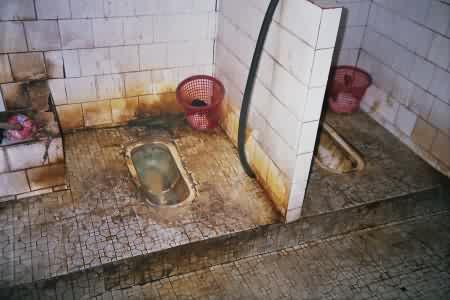

Above, a typical sight in Indian (or other developing country) toilets. The lack of running water and improper drainage means the toilets clog and don't work. Would you use this toilet?? Below, a woman sweeps raw sewage that is blocking a drain. Right next to it, runs a water pipeline. Both are cases of irresponsible design and engineering.
Recently I was approached by a group of people looking to fund "sanitation schemes' in India. I sat them down to get a better idea of what exactly they were looking for. They wanted to "build toilets in Indian schools that educated the poor," they said. Besides that, I could "let my imagination go." I asked them what budget they had in mind. "Well, I've heard that you are a good person. So just write something that makes sense." (This was my mistake...I should have nailed down a number before moving on...a lesson I've learned since!!) But I was inspired. Finally someone who trusted my judgement!!
So I sat down and wrote something up. I thought about all the problems I had encountered in the field over the years -- random water pipes that either connected to nothing or a a dried up well, toilets that failed because they had no water access, and horrible sewage overflows from badly designed systems. These had taught me the importance of thinking holistically. If I ever got a chance, I had promised myself that I would design differently, more holistically.
The first thing I did was assume that the prototype school had to be in a village with good water access. Regardless of what people say, unless you've been brought up with them, dry or waterless toilets remain unused, particularly when you are dealing with uneducated people.
Then I designed the toilet. And I tripled the number to be built. What people don't realize is that few things in poor areas work. And when something works, the whole village or slum or community starts to rely on it. So even if the toilets were designed for the school, chances are that the whole village will start using them at some point. Better to design with that in mind, rather than have a war break out between the school authorities and the villagers (I have heard about these cases!), atleast until there is money to build toilets in the village proper. Besides, its not such a bad thing to give adults a reason to come to the school!!
The sewage had to go somewhere in a safe way. So I designed a very basic treatment system, that let grey water irrigate the prototypical kitchen garden that the school would have.
Then I designed the water system. A simple one that would incorporate a water filtration mechanism for drinking water (this involved electricity...but i would downsize to something more appropriate depending on local electricity and water conditions).
Thus, I had a good holistic system in place. I did a basic set of calculations and proudly marched over to hand the proposal into the folks I had spoken to. They took one look and turned me down flat.
"What is all this nonsense??" they snarled, "We just wanted to build some toilets. Why are you putting all this unnecessary stuff in?? I know how much building a toilet costs!! And this is too much." I tried explaining where I was coming from and why I had put in the extras. I even offered to cut my fees down. But they refused.
This isn't something new. Even as I speak, several thousands of "aid" toilets are being built around the world without a care to the local geographical conditions, or socio-economic conditions. It is enormously frustrating to be called up later, during a cholera outbreak or some other public health disaster and know why it was happening in the first place.
If we are to build better systems, build more holistically. Its more expensive in the short term, but will pay huge dividends in the future.
Wednesday, October 7, 2009
Get some $$$ for your jingle!!

Got this in my email this morning. Write in...you never know if you might win!
(wait that's a great jingle already!!) :-)
________________________
Global handwashing day contest
As a contribution to Global Handwashing Day on October 15, 2009, the IRC/USAID Sanitation Updates news feed is having a Handwashing Slogan Contest.
- Participants may enter as many slogans as he or she wishes
- Each slogan must be 8 words or less
- October 13 is the contest deadline
- Contest winners will be announced on October 15th and 1st, 2nd and 3rd place slogans and authors will be featured on Sanitation Updates
Please post slogan submisisons in the Comments section of Sanitation Updates, http://sanitationupdates.
Examples of slogans include:
- Be aware, wash with care!
- Filthy fingers forecast sickness and sadness.
- Drown a germ and wash your hands!
********
"Enhancing U.S. Leadership on Drinking Water and Sanitation"
You may be interested in a report that was recently released by the CSIS Global Health Policy Center : “Enhancing U.S. Leadership on Drinking Water and Sanitation - Opportunities within Global Health Programs” by Katherine Bliss, a CSIS Senior Fellow.
Here is an excerpt from the introduction:
“With the Obama administration's announcement of a new Global Health Initiative, the time is right for U.S. agencies to assert political leadership in addressing the persistent and significant global health challenges related to water and sanitation. This report focuses on the links among water, sanitation, and the health sector and identifies opportunities for greater U.S. engagement on water and sanitation as global health challenges.”
A digital version is available : http://csis.org/files/
*********
Thursday, September 17, 2009
Letter from the Field: South Sudan
Instead of my usual babbling, I thought you would enjoy an actual letter from the field.
________
Before there was Lisa, there were escapades in Central Asia and East Africa and South Asia and Melanesia. Before that, Melbourne, city I love. But before all those things there was Haroun, the embodiment of a place that had caught my heart. Once upon a steamy summer evening in Atlanta, after I had helped Haroun’s family move into their new apartment, we went next door to join four other families. The people inside, black as night with tribal markings sketched into their foreheads, stood silently in the corners of the room, in the way that refugees learn to do. We broke bread. The room was filled with melodies of praise sung by voices seeped in red soil and baked by an African sun. I stood transfixed. “You will make it to southern Sudan someday,” Haroun leaned over and whispered to me. Perhaps Haroun was a prophet.
What’s it like to finally arrive in a place that you’ve been interested in for over a decade?
Well for one, it’s being towered over by a tall soldier who’s ensuring that you are deleting the photo you just took as you walked across the tarmac from the plane.
“I’m sorry. It’s my first time in Sudan and I wanted to get a picture of arriving,” I say as I press the delete button at the bottom right of the camera. The soldier stoically stares at the next photo that appears on the screen. It’s a photo I took while Lisa and I were driving down the LA freeway to the airport. “That’s from Los Angeles, not here,” I assure him. He nods and motions me towards arrivals.
Turns out that the airport isn’t the only place in Juba where uniformed men disapprove of cameras toted by foreigners. The streets, the marketplaces, anywhere near the parliament building, and especially crossing the Juba Bridge, the only crossing of the Nile for over 500 kilometers to the north or south. But if you want to photograph the Juba Bridge, you just go over to the fancy restaurant with its white polyester tablecloths situated on the bank of the river 250 meters downstream from the bridge. Order and coke and take as many photos as you like.
I’ve come to Juba to do an evaluation of the USAID funded Juba urban WASH (water, sanitation and hygiene) project. Before I left I was under the impression that I’d be walking around with groups of project staff doing household surveys and leading focus group discussions and inspecting construction quality of toilets. Before I left I was also under the impression that I’d be evaluating the first ever piped water network in Juba’s history. I was wrong, on both accounts. Turns out that back in the 1920s when the British were still the colonial power, they installed over 50 kilometers of pipes in what was, at the time, quite a remote outpost town. The water system hasn’t been upgraded or maintained during the past 60 or so years that Sudan has been embroiled in its particularly vicious civil war.
As turns out, USAID also didn’t want me to lead teams of Sudanese staff traipsing around Juba interrogating people about their toilet use and handwashing practices. I came to realize on my first afternoon in Juba that my job was to interview a lot of government officials, to examine the policy framework of the new-ish, quasi-autonomous government of South Sudan, and to provide strategic recommendations as to how USAID should further invest in urban WASH in South Sudan (and indirectly, about how to assist the quasi-autonomous nascent government).
Juba 2009 has whispers of Kabul 2003. Bustling, hopeful. On the streets craftsmen are making furniture, welders are fusing iron gates. People are buying and selling. Music emanates from bamboo-walled restaurant shacks. Motorcycles zip about. Mobile phones charging at wooden stands. All in a city where there’s no electricity grid. Juba’s booming.
At newly opened restaurants where Kenyan and Ugandan wait staff serve cold drinks and imported food to the throngs of foreign businessmen and aid workers, the faces from Europe and North America sit at broad tables with their compatriots from East Africa. They talk of low capacity in South Sudan, lower than anywhere else they’ve worked. Of the restlessness of the population, since benefits from the peace dividend have turned out to be lower than what was expected. The elephant in the corner of the room is the referendum that’s scheduled to occur in about 18 months. According to the arrangements of the 2005 peace agreement, South Sudan gets 6 years of autonomous rule and then there’s a referendum where southerners get to vote on secession. Everyone expects an overwhelming yes vote from the population. No one expects the government in Khartoum to allow it to happen, this being the same regime that has waged a repressive war against the south for as long as anyone can remember and then a few years ago decided to shift war efforts to a once unheard of part of Sudan called Darfur. And just in case you were wondering, the oil fields are in South Sudan.
The lodge where I’m staying is at the edge of the rapidly sprawling city. It’s really nice accommodation, especially for Juba standards. A year and a half ago the population of Juba was around 250 thousand, there were 6 km of paved roads, and $100 a night would get you a canvas tent and a shared pit latrine. Now there around 400 thousand in Juba, about 20 km of paved roads, and $150 a night gets you a private air conditioned hut inside a barbed wire fence containing one of the three pools in South Sudan. In between the huts, the grounds are covered with portulacas. In daytime the flowers open up, transforming the land into a carpet of purple. As you walk around Juba, even in the areas where there isn’t any running water – much less swimming pools – you see that families have planted portulacas. Patches of hopeful purple flowers in a sea of brown dust. In Juba Arabic they’re called “sahb ahkeer,” which means “flower of sunrise.” I hope it’s sunrise for Juba; for South Sudan.
“I hope your son is able to return to South Sudan someday,” I told Haroun a decade ago, when last I saw him.
I’m still hoping.
Love from South Sudan,
Mike
Friday, July 10, 2009
Links I liked
1. If you've ever been unhappy at work and considering quitting, read this post. It also has the best resignation letter ever.
2. Being a geek myself (and sometimes described as "Vulcan", if you are a Trekkie), I'd highly recommend reading this bit on the top ten mistakes people make when managing geeks. In fact, its so popular (and sanctioned) that its been voluntarily translated into 10 different languages, including Persian and Danish
3. An award-winning toilet made from horse-dung. Would you use it?? I would! Truly amazing what good design mixed with decent engineering can do. Here's another example of good design, good idea, and good engineering.
4. Love reading while taking a dump?? Here's an innovative new dual purpose toilet book...literally!
5. Do our things make us happy?? Happiness Objectified...a must read on a survey done.
Sunday, April 13, 2008
Estamos Founder (who focuses on clean water and eco-sanitation) wins Goldman Prize

Feliciano dos Santos talks to a rural community about clean water and sanitation (Photo: John Antonelli for the Goldman Prize)
Today, I was reading about the winners of the Goldman Prize, which is...
...the world's largest prize honoring grassroots environmentalists... Founded in 1990 by Richard and Rhoda Goldman, the Goldman Environmental Prize annually awards US$150,000 to environmental heroes from each of the world's six inhabited continental regions.Turns out one of the 2008 winners is Feliciano dos Santos, a Mozambiquan musician who has spent the past 10 years providing and promoting safe water and ecological sanitation to rural communities in Mozambique through an organization he cofounded called Estamos. In 2005, I had the opportunity to work extensively with Estamos in Maputo doing wat-san work. They were a wonderful community-based organization and had tremendous trust within the communities they worked in.
Feliciano is cool for more reasons. He has also started a musical band called Massakos, and he uses the music to promote hygienic practices, clean water, and sanitation in the communities. The music is catchy, and his number one hit "Wash Your Hands" has even become an international hit! He has now signed with UK-based Poo Productions (gotta love the name!) which promotes bands and films that also focus on awareness of water and sanitation issues in the developing world.
The websites are all great, with documentaries and music for you to check out. And if you like the music, buy it! Proceeds from music sales go to support Estamos and other wat-san projects for the poor. Also, BBC recently did a write-up on him, which is also very good.
Subscribe to:
Posts (Atom)

 Posts


