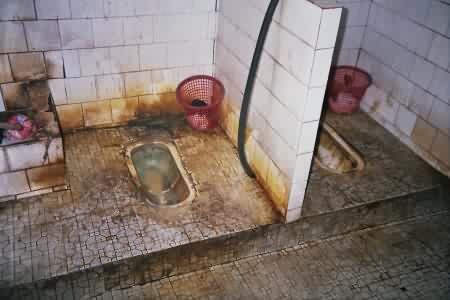

Above, a typical sight in Indian (or other developing country) toilets. The lack of running water and improper drainage means the toilets clog and don't work. Would you use this toilet?? Below, a woman sweeps raw sewage that is blocking a drain. Right next to it, runs a water pipeline. Both are cases of irresponsible design and engineering.
Recently I was approached by a group of people looking to fund "sanitation schemes' in India. I sat them down to get a better idea of what exactly they were looking for. They wanted to "build toilets in Indian schools that educated the poor," they said. Besides that, I could "let my imagination go." I asked them what budget they had in mind. "Well, I've heard that you are a good person. So just write something that makes sense." (This was my mistake...I should have nailed down a number before moving on...a lesson I've learned since!!) But I was inspired. Finally someone who trusted my judgement!!
So I sat down and wrote something up. I thought about all the problems I had encountered in the field over the years -- random water pipes that either connected to nothing or a a dried up well, toilets that failed because they had no water access, and horrible sewage overflows from badly designed systems. These had taught me the importance of thinking holistically. If I ever got a chance, I had promised myself that I would design differently, more holistically.
The first thing I did was assume that the prototype school had to be in a village with good water access. Regardless of what people say, unless you've been brought up with them, dry or waterless toilets remain unused, particularly when you are dealing with uneducated people.
Then I designed the toilet. And I tripled the number to be built. What people don't realize is that few things in poor areas work. And when something works, the whole village or slum or community starts to rely on it. So even if the toilets were designed for the school, chances are that the whole village will start using them at some point. Better to design with that in mind, rather than have a war break out between the school authorities and the villagers (I have heard about these cases!), atleast until there is money to build toilets in the village proper. Besides, its not such a bad thing to give adults a reason to come to the school!!
The sewage had to go somewhere in a safe way. So I designed a very basic treatment system, that let grey water irrigate the prototypical kitchen garden that the school would have.
Then I designed the water system. A simple one that would incorporate a water filtration mechanism for drinking water (this involved electricity...but i would downsize to something more appropriate depending on local electricity and water conditions).
Thus, I had a good holistic system in place. I did a basic set of calculations and proudly marched over to hand the proposal into the folks I had spoken to. They took one look and turned me down flat.
"What is all this nonsense??" they snarled, "We just wanted to build some toilets. Why are you putting all this unnecessary stuff in?? I know how much building a toilet costs!! And this is too much." I tried explaining where I was coming from and why I had put in the extras. I even offered to cut my fees down. But they refused.
This isn't something new. Even as I speak, several thousands of "aid" toilets are being built around the world without a care to the local geographical conditions, or socio-economic conditions. It is enormously frustrating to be called up later, during a cholera outbreak or some other public health disaster and know why it was happening in the first place.
If we are to build better systems, build more holistically. Its more expensive in the short term, but will pay huge dividends in the future.


 Posts
Posts


