Showing posts with label drinking water. Show all posts

Wednesday, July 21, 2010

Watch "Water on the Table"

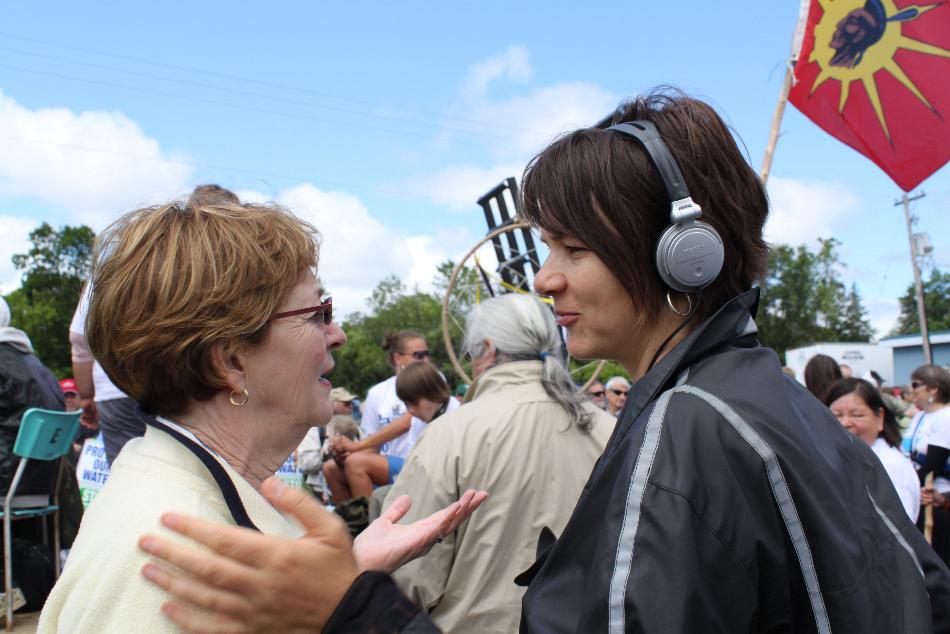
Filmmakers Maude Barlow and Liz Marshall talk during the filming of "Water on the Table." (Click on the picture for original photo source)

Have you seen Water on the Table?? It is a film by Liz Marshall and Maude Barlow, about the humanity of water. I first heard about it when it was featured in one of my college auditoriums at Lake Forest College in the US. Along with promoting this documentary, the book Blue Gold written by Barlow and Tony Clarke, was also promoted. It is claimed that film director, Liz Marshall, was truly inspired by the book and had decided on bringing a visual aspect to pass on the message.


The message was simple-“water is a human right and not a commodity to be bought and sold like oil and sugar.” This documentary is both beautiful and poetic, as well as controversial and thought provoking.

If you have not seen it, I would strongly recommend doing so.

More links:
Water on the Table main website: http://www.wateronthetable.com/
You can also follow them on twitter: @wateronthetable

------
This is the first in a series of posts by KS, an intern who is working with me over the summer.

Saturday, January 30, 2010

The Need for Well-Rounded, Holistic Thinking


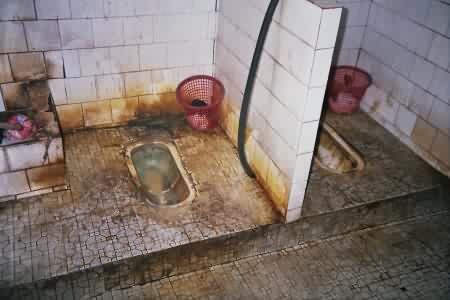
Above, a typical sight in Indian (or other developing country) toilets. The lack of running water and improper drainage means the toilets clog and don't work. Would you use this toilet?? Below, a woman sweeps raw sewage that is blocking a drain. Right next to it, runs a water pipeline. Both are cases of irresponsible design and engineering.


The "Aid World" (i.e. all the organizations/companies involved with the collection, distribution, and disbursement of international aid) desperately needs more holistic thinking. Without it, little sustainable change will happen.

Recently I was approached by a group of people looking to fund "sanitation schemes' in India. I sat them down to get a better idea of what exactly they were looking for. They wanted to "build toilets in Indian schools that educated the poor," they said. Besides that, I could "let my imagination go." I asked them what budget they had in mind. "Well, I've heard that you are a good person. So just write something that makes sense." (This was my mistake...I should have nailed down a number before moving on...a lesson I've learned since!!) But I was inspired. Finally someone who trusted my judgement!!

So I sat down and wrote something up. I thought about all the problems I had encountered in the field over the years -- random water pipes that either connected to nothing or a a dried up well, toilets that failed because they had no water access, and horrible sewage overflows from badly designed systems. These had taught me the importance of thinking holistically. If I ever got a chance, I had promised myself that I would design differently, more holistically.

The first thing I did was assume that the prototype school had to be in a village with good water access. Regardless of what people say, unless you've been brought up with them, dry or waterless toilets remain unused, particularly when you are dealing with uneducated people.

Then I designed the toilet. And I tripled the number to be built. What people don't realize is that few things in poor areas work. And when something works, the whole village or slum or community starts to rely on it. So even if the toilets were designed for the school, chances are that the whole village will start using them at some point. Better to design with that in mind, rather than have a war break out between the school authorities and the villagers (I have heard about these cases!), atleast until there is money to build toilets in the village proper. Besides, its not such a bad thing to give adults a reason to come to the school!!

The sewage had to go somewhere in a safe way. So I designed a very basic treatment system, that let grey water irrigate the prototypical kitchen garden that the school would have.

Then I designed the water system. A simple one that would incorporate a water filtration mechanism for drinking water (this involved electricity...but i would downsize to something more appropriate depending on local electricity and water conditions).

Thus, I had a good holistic system in place. I did a basic set of calculations and proudly marched over to hand the proposal into the folks I had spoken to. They took one look and turned me down flat.

"What is all this nonsense??" they snarled, "We just wanted to build some toilets. Why are you putting all this unnecessary stuff in?? I know how much building a toilet costs!! And this is too much." I tried explaining where I was coming from and why I had put in the extras. I even offered to cut my fees down. But they refused.

This isn't something new. Even as I speak, several thousands of "aid" toilets are being built around the world without a care to the local geographical conditions, or socio-economic conditions. It is enormously frustrating to be called up later, during a cholera outbreak or some other public health disaster and know why it was happening in the first place.

If we are to build better systems, build more holistically. Its more expensive in the short term, but will pay huge dividends in the future.

Tuesday, October 20, 2009

Question from a reader: Fixing water filtration in India


A simple sand and activated charcoal filter ($10-15) can filter hundreds of gallons of water simply and cheaply. But will this solve India's (bottled) water issues?? Read on... (photosource: bethechangeinc)


I got the following question in my inbox recently. Its becoming a question of increasing frequency, and I want to address it properly. Here's the "question" the reader wrote:

Last year, after a research expedition [on the effect of plastics on the environment]...we were giving talks and meeting with legislators along the way [in North America].

At one of our talks, a woman who had just returned from a long trip in India approached me, and said, "this is all great what you guys are doing to educate people, BUT there are much larger problems with plastic bottles and waste overseas". She told me that due to poor sanitation, in some areas she'd been in, people had no choice but to drink out of plastic bottles, and lacked the infrastructure to deal with them.

Which made me wonder if bringing water filtration systems to India might make a difference, albeit small.... for peanuts here ($500-$1000), an entire school can have clean water.

I've never been to India, but would be interested to hear your thoughts. Perhaps we might try to raise money for a few filters, to start with...

Here was my response:

I agree with the bottled water issue. As much as I detest bottled water, I find that when I'm in the developing world for very short bursts (where I don't have the time to purge my system and adapt) and need reliable, safe water quickly, I rely on bottled water (note: I try to drink tea, boiled water, other boiled beverages or soups for the most part, and only eat fresh, cooked food. Bottled water is a substitute when I can't find these or its simply too hot!). Amongst poor communities, plastic bottles are a huge commodity. Recycling goes on in full, plus the thicker, better bottles are used as water bottles or to store other liquids. They use these for several reasons -- convenience, cost (free to find, recyclable when they are done, easy to replace), how light it is, how sturdy it is, its lack of brittleness, etc. And yes...often they have no other choice.

Water filters are available in abundance in most of the developing world, particularly in non-disaster zones. India has a lot of indigenous water filters that do a very good job...most selling for around $50-$100. Most middle, upper, even poorer class Indians have them installed in their houses, though the best and most effective need access to electricity (they are RO systems). If you really want, you can build one using sand and a large bucket (or see diagram above). This is how most wastewater is treated in the US, though on a much larger scale. Clear water combined with some bleach dosing (aka chlorine disinfection), should render perfectly safe and drinkable water, and all for less than $10.

Probably best of all, there is always the option of boiling...the problem with this is that its very energy intensive and if you use wood/charcoal/kerosene, its simply too expensive. (I tend to boil my water usually in the developing world, except when i've run out of my supply and then use the water i find either at a tea shop or i buy bottled water).

Sometimes its not the filtration that's the problem....its the sourcing of clean water, the collection, the transportation, and the storage of water that are the biggest issues. Outside of the sourcing issues, plastic generally fills these voids.

Of course, for problems like arsenic, fluoride, salinity, etc, where you need more advanced cleaning, or where the water is extremely turbid (cloudy or visibly dirty), it becomes a different issue. These are very regional issues, and generally you can figure out what the biggest water problems in that area are by visiting the NGOs, doctors or govt public health agencies in that area. If its pathogen-related (which is the majority of water quality issues), then generally some proper boiling or filtration/disinfection will quell the problem. But other issues need more specialized solutions.

Finally, I'm not a huge fan of transplanted filters or other mechanisms. Filters from here are not made to withstand water or field conditions there. Expensive systems have a short shelflife, then like every other good transplant, they wither and die. This is partially because there is no one to do regular operation and maintenance, or who has been trained properly to fix even the smallest problems. A COMMON problem is letting untrained hands take over the operation of a technology. Their curiosity gets the better of them, and the technology is quickly rendered useless. Replacement parts are hard to find and buy, and the issue of untrained hands repeats itself. Always look for indigenous units, you are much more likely to have success in terms of adoption, operation/maintenance, and replacement if necessary.

These are my immediate thoughts on the subject. I'm always happy to discuss this further with you...

Thoughts anyone??
Friday, May 2, 2008

An Update on the Aquaduct

A few weeks ago, I blogged about/reviewed a technology called The Aquaduct. As stated in that post, I had emailed the team a few questions that I couldn't find answers to. It took them three weeks to respond, and they sent me a generic answer after all of that. But apparently, they've started a blog with the first post answering a lot of my questions, including how they came up with their design, the type of filter they used, the cost of their product, and where they were heading with it.

Frankly I'm a bit disappointed with the vagueness of their answers. Still it atleast scratches the surface...


Friday, April 18, 2008

Water Exercise: Water-Use Calculator


Calculating your water usage is an important step to increasing the availability of water for others. (photo source: Sneske@gastronomic Fight Club)

Unilever and Zerofootprint.net have teamed up to come up with a one-minute water calculator. Answer a few questions and you'll know how much water a year you are using per year. You can also see what activities are your biggest "water guzzlers" and what to do about them.

I almost highlighted this as a technology, as I think that the only way to increase availability of water resources in other parts is to decrease their use in water guzzling nations like the United States, Canada, and Europe. And anything that makes us aware of our wastage works for me.

What few people realize is that there is only a finite amount of water (and drinking water) on this earth. With our continuous wastage and pollution, this precious resource is slowly ebbing away. Our hogging of water is taking away water from other areas, ones that are far more desperate than us, and where a liter of water means the difference between life and death.

Also, once you are done calculating your water usage, keep in mind that the World Health Organization (WHO) mandates a minimum of 20L (5.29 gal) of water per person per day, which means about 7300L (1931 gallons) per person per year. The reality at the moment is that most of the poor in the developing world live on far less than that.

Thursday, April 17, 2008

Water Technology: The Playpump


Children ride around on a Playpump in South Africa that provides water to their school! (photo: project H Design)

Technology Name: PLAYPUMP


Description:
In a nutshell, the Playpump is quite simply a pump. It uses energy from a merry-go-round to pump groundwater into an overhead water tank.

Playpump is the brainchild of Trevor Field, a former marketing/advertising exec. He says he saw children playing around one day in South Africa and wondered if he could harness that energy to pump water. Now children are encouraged to play so that they can bring water into the school!


The playpump really works that simply. Rotational movement from the merry-go-round(1) goes to pump clean water(2) from the ground into an overhead tank(4). Water from the tank then operates on gravity and is collected by tap in some convenient locations(6). The traditional ubiquitous tubewell (see photo) also operates on the same mechanism, only it uses an up-and-down motion rather than a circular motion. (photo source: Playpumps International)

Playpump won the World Bank Development Marketplace (DM) prize in 2000, and has grown by leaps and bounds since then. Trevor registered his organization as Playpumps International. You can visit their website here.

Here's how it works:


And here is National Geographic's recent piece on it:


My review:

I came across Playpumps International (PI) in 2005, when I got very involved with the Development Marketplace (DM) challenge. At that point I was consulting with some of the finalists to help make improve their business plans for the competition. I was struck by the simplicity and large impact that PI could potentially have. Essentially I was hooked.

The good:
Well, what's not to like about this?? Its a clean, simple concept that addresses a desperate need, and it really works.

I also love PI's total sustainable business concept. All parts are manufactured locally. They hire and train local help, and they generate revenues from advertising on their water tanks. They go a step further as well, in that all their advertising must include HIV/AIDS prevention messages or other such health-related messages. That's a really sustainable

The what:
To be honest, I don't know if there is a "what" for this project. I can't quite see a flaw in the technology. I've heard complaints from some organizations that the concept isn't working as well as PI advertises, but how true that is or why that is, I'm not sure. I'm hoping some reader can shed light on this.

I'll be honest though, I'm not crazy about their merry-go-round design. I think that can definitely be done better, and they can probably set up an entire playground while they are at it. But that's a different story.

Variations I would suggest:
Not much. I just think the merry-go-rounds can be better designed. But more importantly:

1. How about getting solar panels on there and making some energy for electricity (and also using the kids leftover energy for the same!) in the school...


Other reviews/information:
World Bank DM Press: Playpump
PBS Frontline/World's story on Playpumps International

Case Foundation's Writeup on PI
http://www.nextbillion.net/activitycapsule/1917

Wednesday, April 16, 2008

Water 102: Rainwater Harvesting or Collection


Every year, thousands of gallons of clean, pure rainwater are lost to floods in some of the most impoverished countries around the globe, countries that are struggling with water availability issues. Here a woman from Hue, Vietnam struggles through a flooded street (source: 1ieve). Why not catch the water and use it, rather than lose it??

I am a HUGE supporter of rainwater collection. In most cases, rainwater is some of the most effectively clean water that you can possibly get. I say most because if the air surrounding the clouds or the air between you and the clouds is polluted (with dust, sulphates, nitrates or other chemicals), the pollutants mix with the rain and contaminate it. Generally highly industrialized areas or desert areas with high dust contents are problem areas. And even in these cases, if it rains continuously in high volumes, then the first couple of rains flush the area out and the next sets become cleaner. And even in these cases, the water is safe for gardening, washing clothes and bathing. It does need to be boiled, disinfected, and/or filtered for cooking and drinking.

Islands and areas with high rainfall, are the perfect places to implement rainwater harvesting. Many of the equatorial regions, which also have high poverty rates would benefit greatly from rainwater harvesting. While the rain is seasonal, collecting and storing water during that period can get one through some of the dryest summers.

The concept itself is simple - find a way to collect the rainwater funnel it into a storage area. So it has three parts:
-a catchment area (a roof, trees, the earth)
-a storage area (pots, tanks)
-piping that takes you from catchment to storage area. It doesn't have to be a pipe, its just a system to take the water from catchment to storage (reeds, pipes, gutters)


The key to a good rainwater collection system is a clean, covered storage area...this is MOST critical. If the collection area is dirty, wait 15-20 mins for the rain to flush off the area, then start collecting after.

By far, one of the best threads on rainwater harvesting in the developing world is here on changemakers. They talk about everything from how to check the quality of your water to how to install the system, etc.

In many cities and towns, water can be collected from roofs using a gutter system that funnels the water into a barrel. In rural areas, this can be a bit difficult with thatched or hay roofs. When large leaves are used it is a bit easier. Still, some of the best and simplest water harvesting I have seen have been in tribal communities across Asia and Africa (haven't been to Latin America yet, though I'm sure they are experts too), who use the trees surrounding their living areas to funnel water into pots.


A woman in rural India collects water using a length of cloth hung between two trees, a weight and a pot. (source: www.poutworld.org)

On Jeju island in Korea, traditional women matt together brush and reeds and let water drip into the pot. Usually for the first rain, the water was allowed to flush the brush, and was used for agriculture only. But after that, the brush acts as a funnel and a filter, and the resulting water is used for everything. (source: James Lim)


A rainwater harvesting system designed by students at Clemson University, South Carolina (source: Clemson U)

Regardless of whether you are in a developed or developing country, I would highly recommend installing a rainwater collection system (you can design your own using the gutter system on your house).


Other resources:
An introduction to Rainwater Harvesting
H2OHarvest.com, one of the best rainwater harvesting websites
Is rainwater clean enough to drink?
Who's up for drinking rain?
Drinking rainwater

Monday, April 14, 2008

Water Technology: The Aquaduct


The IDEO team pose with their winning technology (photo: examiner)

Technology Name: AQUADUCT


Description:
In a nutshell, the Aquaduct a pedal powered water transportation and filtration system.

Aquaduct was designed by a team of IDEO folks in response to the Innovate or Die competition 2007, sponsored by Google and Specialized Bicycles. It placed first. The rules were simple:
  • Invent an unheard of, unprecedented pedal-powered machine, build it and film it. Just make sure that your innovation has human pedal power as its original source.
  • You may either ride solo or build with a team of up to five people.
  • Individual entrants (or the team contact) must be registered members of YouTube at the time of entry, be at least 18 or older and be residents of the U.S., Canada, France, Ireland, Italy, Japan, The Netherlands, Poland, Spain or the U.K.
Here's the basic layout and design of it:


My review:
The Aquaduct basically helps with transportation, filtration, and storage, (and disinfection?? need to check on this).

The good: It uses bicycles (with parts that can be found in even the remote parts of any developing country) and human power (probably the only thing they can count on in poor areas); it looks cute, and combines several different water processes into one unit. The filter is just representative of other more locally available filtering systems that we can find. I love the fact that the water is covered at all times, which keeps it from being contaminated further. And I love the pedal-powered pump.

The what: Ummm...bicycles being used to transport water or anything else in developing countries are not new. Infact bicycles are the first transportation vehicles that a poor person will invest in. And they've been using bicycles to transport water and everything else for centuries. So why would anyone invest in this tricked out tricycle that carries only water??

And cost-wise, bicycles are luxury items to being with, in many of these parts. So you have to make it functional. Essentially, think about the cost and then double the amenities that come with it or it will fail.


Bicycles are crucial transportation for the poor, and a luxury. On the left, Ugandan boys carry jerry cans of water back home [1]; on the right, an Indian boy carries cans of water, petrol and a friend on a tricycle [2]. If Aquaduct wants to succeed, it must expand its functionality.

Variations I would suggest:

1. Most poor people I've gone water hunting with, carry plastic or clay pots (the clay keeps the water cold), or large 20 gallon plastic jugs (aka jerry cans). The Aquaduct should actually include areas to load existing water jugs and filter into existing water jugs, not new ones that you sell with the tricycle.

2. Make the rear storage unit a "clip-on" so that they can take that thing out and carry other things when they need to.

3. I love the peristatic pump. Is there any way you can design it so that the pedal-power can be used to pump water directly from the ground? or transfer to power other things?? Poor people WON'T invest in this unless it can serve multiple purposes.

[1]: Source: Staffordshire Learning Network
[2]:
Source: People's Daily Online

Other reviews/information:
http://www.ohgizmo.com/2008/03/12/aquaduct-is-a-pedal-powered-water-purifier/
http://urlgreyhot.com/personal/weblog/innovate_or_die_winner_aquaduct
http://www.dezeen.com/2008/03/11/aquaduct-by-ideo/
http://mellowvelo.blogspot.com/2008/01/aquaduct-mobile-filtration-vehicle.html
The very uninformative Innovate or Die website
The inspiration behind Innovate or Die:

Saturday, April 12, 2008

Water Pollution: The Great Pacific Garbage Patch

An oceanographic vessel saw a giant unending patch of garbage floating around in the middle of the ocean. This is very much a current topic and provides a good idea of water pollution and how it happens.

This post includes a video of people who actually sail out to check it out for themselves.

http://www.treehugger.com/files/2008/04/great-pacific-garbage-patch-trash-vortex.php

Water availability: Water Wars


An Ethiopian pastoralist crouches down at the edge of a dry crater that was a large watering hole for his livestock. Drought and other issues are shrinking water availability, increasing tensions in communities across the globe (photo credit: Andrew Heavens)


While energy production and the lack of it is taking centerstage right now, I believe the water availability problem is just barely hanging out below the surface. When it bursts, it will be BIG.

As discussed in the Water Problem post, water availability is a MAJOR problem. With a growing population, increasing pollution, and climate change causing extreme weather conditions like droughts, communities around the world are clashing (sometimes violently) to stake out dwindling water reserves.

The New Scientist today posted an interesting article about Barcelona's attempts to buy boatloads of water from France. Here's a bit:
As Barcelona runs out of water, Spain has been forced to consider importing water from France by boat. It is the latest example of the growing struggle for water around the world – the "water wars". [...]

If you are interested in the topic of water wars, here are a few resources to get you started:

- Blue Gold, the book. Also here's a preview of the powerful documentary based on the book:


- Popular journalist Daljit Daliwal's piece on the subject, in ethiopia.


- HBO's film "H2O up for sale" gives more information on this:


- here's the link to Botswana's existing water wars. I can't embed, but you can watch 20 mins of the documentary by following this link.

- If you think that water wars aren't a part of the United States, think again. There is plenty of literature out there about California's and Michigan's water wars. Here Jim Lehrer does a piece on his Newshour program on PBS.

part 1: (4 mins)


part 2: (4 mins)


- Vandana Shiva's (2002) book Water Wars.

- The Global Policy Forum's collected links on previous water wars.

- Water Wars and International Conflict, a website put together by the Univ of Wisconsin in Eau-Claire

- World Water Wars.com

Monday, April 7, 2008

Masaai Marathon for Water!


Here's some current news to put all the water stuff we've been talking about into perspective.

Tomorrow, a group of six Masaai warriors from northern Tanzania will attempt to run the London Marathon with the hopes of winning the grand prize money. Their motivation?? The money will be used to build watering holes in their villages. You can read more of their article on Yahoo news! here. But here's some to give you a taste:
They survive on fresh blood drained from the neck of a living cow, they often run for days and nights on end to find water and their shoes are made from car tires cut up and strapped to their feet.

So running the London Marathon should be no problem for six Maasai warriors who have come to Britain from their village of Elaui in northern Tanzania as part of a campaign to raise money to find a vital water source (www.maasaimarathon.org).

"Back at home we sometimes run for 5 or 6 days, day and night," Isaya, a young warrior clothed in a red robe and adorned with traditional beaded jewelry, told Reuters in an interview. "Twenty-six miles not far." [...]

Saturday, April 5, 2008

Water 102: Water and Wastewater Treatment Plants


photo credit: Andrew Wallace

Its time to move on. Granted we're making a big jump from the basics to the more advanced. But I'll try my best to explain this as simply as possible.

Water (and wastewater/sewage) treatment can be done on an individual basis or en masse. Treatment plants are just mass water decontamination sites. They both use a combination of the processes discussed in "Water 101: Decontamination" to clean water.

Most developed countries (and the urban areas of developing countries) use centralized water distribution and sewer collection systems. Centralizing water and wastewater have their ups and downs, and I don't necessarily think that centralizing everything is the best way for every country, but its the way things are done at the moment.


Schematic Diagram of a Wastewater Treatment Plant (source: Ohio State University)

What's the difference between a water and wastewater treatment plant??

Generally, its the type of water that comes in--a Water Treatment Plant (WTP) generally takes water from ground, surface, or rainwater sources, makes it drinkable and distributes it to water storage tanks or directly to people; a Wastewater Treatment Plant (WWTP) generally collects sewage and other waste water (and in some cases stormwater) from various sites, cleans it and releases it back into the environment at a safe level for humans, fish, and plants to be around. Golf courses or parks that say "watered with reclaimed wastewater" often refer to this water.

WTPs generally are smaller operations than WWTPs, because of the water quality coming in. Generally WTPs just need a bit of cleaning and disinfection (because the water is generally clean already). WWTPs take pretty nasty sewage water (from industries and homes and businesses and schools) and get rid of most of the nastiness. This is why WWTPs are much larger and more elaborate. The solids generally end up going to landfills, the liquid (water) is cleaned and purified until it is safe for humans, animals and plants.

Is reclaimed wastewater potable??

Depends...on how clean they (the WWTPs) make the water before releasing it. It is definitely possible to take wastewater and put it through a series of cleaning steps to make it potable. But it can be expensive, which is why most wastewater treatment plants in the world don't generally do these extra steps. But as clean water resources get scarcer and the human population grows, it will become increasingly likely (and less expensive) to create fully recycled water plants.

Personally, I think the biggest barrier is not the technology or the expense, but rather the human factor. People are just not comfortable drinking water that entered a factory as sewage a few days before.


Reclaimed water: potable or not?? (photo credit: Peyri Leigh)


Resources:
Howstuffworks.com : Wastewater plants

The USGS site for wastewater Treatment

How Water Treatment Plants work

FAQs about WWTPs

http://www.ec.gc.ca/soer-ree/English/soer/MWWE1.cfm
The Water Environment Federation's engaging presentation on WTP and WWTP

Using microorganisms in cleaning up water

Friday, April 4, 2008

Water 101: Decontamination, the basics


Clean drinking water - the goal of decontamination [1]

In my last post of the 101 series, we discussed how water contamination happens. In this post we'll talk about how to decontaminate water.

Decontamination really involves two main steps:

1. Figuring out what the contaminants are, and their levels of concentration:


As we talked about before, most contaminants cannot be seen by the human eye. You need to do a series of lab tests on the water to determine the types of contaminants and their concentrations. The concentration of the various contaminants is particularly important because you need to know how dangerous the water really is, and how powerful a cleaning process you need. The United States Environmental Protection Agency (US EPA), the European Union (EU), and the World Health Organization (WHO) (each country has their own such organization as well) all outline safe levels of contaminants for the human body. The thing is, many contaminants are naturally occurring in water, and they are not harmful upto a certain levels. It is beyond that level that the contaminant is dangerous for human consumption, and that's the point that a cleaning process needs to be used.


Water samples need to be lab tested to determine contaminants [2]


2. Using a series of cleaning steps or processes to remove the contaminants:

Once you have determined the nature of the contaminants and their concentrations, you need to find the right processes for each contaminant.

Decontamination generally involves the following overarching processes or a combination of processes (this is an oversimplified version, we can get into the details later):


A series of cleaning processes can get the water on the left to be clean like on the right [3]

a. Sedimentation:
This is the best process for separating liquid and solids. Essentially you take the dirty water and let it sit for a while. Gravity kicks in, and all the heavier stuff will settle at the bottom (flotation, where lighter stuff floats on the top of the water and is skimmed off, is a subset of sedimentation).


Water sedimentation: notice how the heavier contaminants have settled to the bottom [4]

b. Decantation: Decantation is the process following sedimentation, where you pour the cleaner liquid (or let the liquid overflow) out, leaving behind the heavier stuff (sediments).


A Cambodian woman decants sedimented water [5]

c. Filtration: Filtration is the process where the most bad stuff gets taken out. Usually you pass the liquid through some sort of porous membrane (like cloth or other things). The bad stuff gets held back or stuck on one side of the membrane, while the cleaner water flows through to the other side. The efficacy of filtration depends on the quality of the filter, like how small the pores in the membrane are and how well it keeps the bad stuff on the other side.


Schematic diagram of a simple water filter. Water first flows through the sand, then the gravel, and finally a cloth filter. The sand and gravel take out the coarser contaminants; the cloth takes out the fine contaminants. [6]


d. Distillation: Distillation is the most effective water treatment process, but it is also the most expensive because of how much energy it uses. Essentially, you boil the water, collect the steam and cool it down. Its effective in removing metals (like arsenic, calcium and magnesium...which is why its good for your iron as it leaves no residue) and killing germs. However the removal of organic chemicals (derived from petroleum or such) have a variable removal rate. Chemicals that have boiling points lower than that of water, for example, will also vaporize with the water and contaminate it even in steamed form. For chemicals like these, advanced water cleaning processes are used.


Schematic diagram of distillation (in a lab). This can be done without the use of lab instruments as well, en masse. [7]


e. Disinfection
: Disinfection is the process of killing germs. Sometimes the water is free of metals and the other grunge, and just has a bunch of germs which need to be killed. Or often, even the cleanest water that is exposed to air quickly gets contaminated by germs in the air or area surrounding the water. Disinfection is generally the last step of water treatment.


A woman disinfects her bucket of drinking water with chlorine. [8]


Photo Sources:
[1]: Tim Norris

[2]: Juvertson
[3]: http://muriellascorneronmoringa.googlepages.com/
[4]: http://www.easttennesseewildflowers.com/Teacher_Resource.php
[5]: Tom Sprague photo
[6]: http://www.blithfieldeducationcentre.co.uk/kp/waterpages/make_a_water_filter.htm
[7]: www.chemistrydaily.com
[8]: http://www.usaid.gov/press/speeches/2005/ty050915.html

Thursday, April 3, 2008

Water 101: the water problem (the video version)

World Water Day, (celebrated this year on March 22, 2008) brought out a lot of publicity on the water crisis.

CBS's Katie Couric did a nice quick take on water stats:


UNICEF's video: how much water do you really need?


Good Magazine's work:


And last but definitely NOT least, Stephen Colbert's take on it:

Water 101: Contamination


Little indigenous kids play in a pond just by an oil field in Venezuela. It is highly likely that the water is contaminated with oil and oil drilling chemicals.
source: Raphael Millan


In the previous Water 101 post, we covered what the water problem is - that there ultimately isn't that much potable (drinkable) water available for us. Really, the problems were accessibility (how to get water) and availability (amount of water available).

So how do we solve these??

Well, infrastructure is a major part of it. Infrastructure is the whole piping/plumbing system that gets water out from where the water is to where people are (usually animals and other plant life naturally go to where the water is...its the people that cause problems). So maybe we should improve water infrastructure and that would solve the problem.

Well, only partially...

Because there is the larger issue of contamination. It doesn't matter if we have the piping, if the water being piped is dirty. So let's start with understanding contamination.

How does water get contaminated??

Webster's dictionary defines contamination as "The process of...being made impure or unclean." So water that is made impure or unclean is contaminated water. Water gets contaminated in two ways:

1. Natural Contamination: This means contamination from non-human involvement. The thing is, all life needs water to survive. This includes pests like mosquitoes, and germs like bacteria, viruses and protozoa that are bad for us, who also go and live in the water. They make it impure or unclean for us causing a range of waterborne diseases like diarrhea and dysentery or water-related diseases like malaria, etc . Another way that water gets contaminated naturally is with high mud content (aka turbidity), salts, and minerals that the water picks up when it lands on or travels through the earth. For example, the soils in parts of South Asia and Africa naturally have very high amounts of arsenic and fluoride, which the water picks up when it is traveling through. These high levels of arsenic and fluoride can make people very sick. Or coastlines generally have a high rate of salinity (salt) in the groundwater, which makes it non-potable (drinkable).


Left to Right: man with advanced skeletal fluorosis[1]; girl with dental fluorosis. Both are caused by excess fluoride in drinking water[2]. Woman with acute arsenic poisoning [3]. Water with high mud content (turbidity) [4]


2. Artificial (man-made) Contamination: This type of contamination is primarily human-induced. Dumping chemicals or waste from industries and homes, as well as overdraining the water table can severely contaminate the precious water resources we have. There are far too many examples of this, including the stories highlighted in the award-winning movie, Erin Brockovich. One of the examples that really (in my opinion) brought industrial water poisoning to light was what has been known as the Minamata Tragedy, where mercury poisoning caused a series of mysterious illnesses. Other examples include the Mono Lake's increased salinity, caused by excessive draining of the lake and its feed rivers.


From L-R: Factory dumping in Minamata [5]. A sign we are all too familiar with, one that indicates polluted water [6]


A common mistake people make, particularly in communities with lesser education, is that they think contamination can be seen or tasted. But this is not the case. Most contamination is not visible to the human eye. For example, water with high fluoride, arsenic, bacteria or viruses, for example, can look just like regular purified drinking water. This is because the particles are so small that they can only be seen under a microscope or with testing in a lab. It is also important to note that its the concentration of these (generally measured in ppm or parts per million, as in parts of dirt per million parts of water) that can be lethal. It is generally safe to assume that water you get from an open-water source (like a lake, stream, river or pond) is contaminated. You definitely need to decontaminate these (we'll talk about decontamination in the next post). Groundwater is generally clean. I say generally because if it has been exposed to air or touched contaminated surfaces, or has mineral contamination, then its still not fit to drink.

Next time (and finally), we'll get into decontamination. And then I can show you all the fun technologies I've been storing up...

sources:
[1]: www.assam.org
[2]: www.unicef.org
[3]: http://www.martiinc.com/arsenic.htm
[4]: http://www.lenntech.com/turbidity.htm
[5]: credit: W.Eugene Smith
[6]: credit: William Hartz

Tuesday, April 1, 2008

Water 101: what is the water problem?


source: http://www.flickr.com/photos/anatomist/221165572/sizes/m/

Right, its about time I get into the meat of technology. My specialties are water, sanitation, and energy. This doesn't mean that I know everything about it, but if you put anything to do with these things in front of me, I'd likely figure it out and understand it fairly quickly. So if you have questions about these, ASK!!

I'm going to start with water technologies. But before we get into the technology, its important that you understand the water problem.

A common question that I'm asked by people is...there's so much water everywhere...how can people just not have access??
So here's your answer:

1. Well, you are right...there's a lot of water on this earth...about 326,000,000,000,000,000,000 gallons (326 million trillion gallons) of the stuff (roughly 1,260,000,000,000,000,000,000 liters). Considering that there are 6.6 billion people, that's like 49 billion gallons of water per person.

2. But most of it is NOT drinkable (also known as non-potable):


percentage of usable water (source: USGS)


water distribution by percentage (source: USGS)

Estimates by geologists and other scientists state that 97-99% (see above pictures) of all that water is stored in the oceans. Oceans have very salty water, which cannot be used for drinking, washing clothes, cooking or for dishes. You can't use it for cleaning either, because the high salt content can corrode or adversely react with many materials (which is why most things dumped into the ocean decay rather quickly than on land). Of that 1-3%, over half is hanging out in the North and South poles in the form of ice-caps and glaciers. The leftover is in the form of lakes, swamps, and groundwater. I'd probably say that's the percentage that's eligible for drinking (with a caveat, see point 3). So now, the water count is more like 158 million gallons of water per person (for your entire life). Assuming you live for 67 years (which is the current life expectancy of an average person in the world), that means you have 6500 gallons a day. Now you might think that's a lot, but its not really...because...

3. Most of the part that's drinkable has issues of pollution, accessibility or availability:


projected annual water available per capita by geography in 2025
source: Water Resources Institute, Page 200

Availability?? YES! Firstly most of this water is not yours. We haven't accounted for the animals or plants or the rest of the ecosystem that share this earth with you (and frankly, outnumber you by a large margin). So that itself, takes the per person amount significantly. Plus the water is often not anywhere near you. Water usually concentrates itself in specific areas, not equally across the land surface. And generally large amounts of water are in places that people proportionately don't live in or near - like forests, rivers, and large lakes. Which means that the water needs to be piped over to you. But if you are in a poor country and don't have the means to pay for a pipe, chances are you won't get any water. And you have to walk miles to fill up a pot of dirty water. Add on top of that the pollution of the few water sources we do have - natural and man-made - and that decreases the accessibility even more. This is how over 1 billion people in the world have NO access to freshwater. So really, there's a shortage of fresh drinking water on the planet!!


(source: http://holamun2.com/wp-content/uploads/2007/08/dirty-water.jpg
http://www.miraclesinaction.org/pb/wp_83f479b6/images/img39644ea612fadd13.jpeg
source: http://www.flickr.com/photos/beija-flor/)

So this is what we are trying to address in the water technology parts - technology that improves accessibility and/or reduces pollution, particularly for the poorer people that have no access.

Please note:
1 gallon = 4.78 liters
1 billion = 10^9 (the US definition)
1 million = 10^6

More information:
United States Geological Survey site for water: http://ga.water.usgs.gov/edu/
The Pacific Institute's Water Think Tank: http://www.worldwater.org/

WHO Water Page: http://www.who.int/topics/water/en/
World Bank Wat/San page: http://go.worldbank.org/PRR44UVHT0
How Stuff Works on water: http://science.howstuffworks.com/h2o.htm
The World Resources Institute: http://www.wri.org/