Showing posts with label water. Show all posts

Thursday, August 26, 2010

Why I've been quiet

A lot of people have been bugging me about my lack of writing on my blog. This is for two reasons:
  • I am in Singapore
  • I am supposed to start a blog around water, sanitation, and hygiene (WASH) issues where I work now. Since there was going to be this overlap, I've focused on the other one.

Singapore (where I am at the moment) is a very difficult place to write from...particularly if you like the idea of freedom and have an independent mind (as I do). Say something people don't like, and you get put on a watch list; sometimes punished severely. If you 'google' around, I'm sure you'll find more interesting information on the subject. Essentially, i don't know what will tick someone off and then I end up with my head on a cross bridge (they have a few here!).

On the second, things are moving slowly where I work. There are many reasons for this. They are restructuring, and there is a war about what we can and cannot post, and the process we have to use. And then there is a war about the name, because it has to represent several different institutions at once.

And while these two issues resolve themselves, I'm working feverishly on keeping the rest of my work going. So I've been quiet.

Wednesday, July 21, 2010

Watch "Water on the Table"

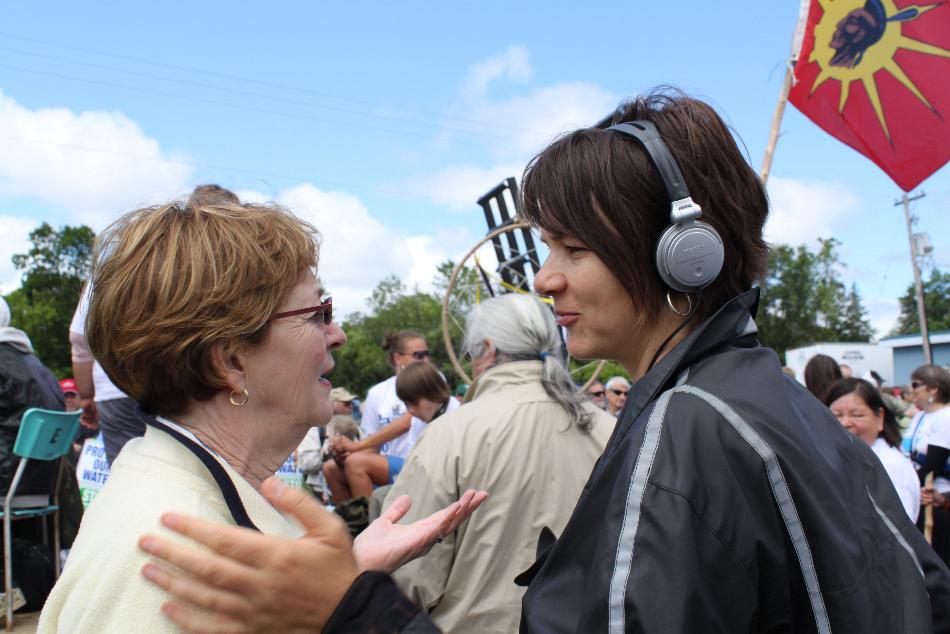
Filmmakers Maude Barlow and Liz Marshall talk during the filming of "Water on the Table." (Click on the picture for original photo source)

Have you seen Water on the Table?? It is a film by Liz Marshall and Maude Barlow, about the humanity of water. I first heard about it when it was featured in one of my college auditoriums at Lake Forest College in the US. Along with promoting this documentary, the book Blue Gold written by Barlow and Tony Clarke, was also promoted. It is claimed that film director, Liz Marshall, was truly inspired by the book and had decided on bringing a visual aspect to pass on the message.


The message was simple-“water is a human right and not a commodity to be bought and sold like oil and sugar.” This documentary is both beautiful and poetic, as well as controversial and thought provoking.

If you have not seen it, I would strongly recommend doing so.

More links:
Water on the Table main website: http://www.wateronthetable.com/
You can also follow them on twitter: @wateronthetable

------
This is the first in a series of posts by KS, an intern who is working with me over the summer.

Friday, July 16, 2010

CHECK OUT the BBC World Debate on Water...airing THIS WEEKEND


Panelists debate water issues at the BBC World Debate, filmed live on location in Singapore. Photo Credit: Institute of Water Policy

A couple of weeks ago, my colleagues and I helped put together the first BBC World Debate on Water. Its the first time that such a major network has done such a high profile debate on the issue of water (and might I say, about time!!).

The event was part of our attempt to bring more public dialoguing about water issues into the limelight. We purposely held it during the famous and very international Singapore International Water Week (a week-long conference that brings together almost 15,000 water geeks from all over the world), so that we could get an international and eclectic audience into the room who could then take their viewpoints to others. Only 250 people were allowed to attend the live filming, and they came from around the world...ranging from high school kids to high profile water ministers.

Feedback has been very positive thus far. And we are happy that you can all finally see it too!!

The BBC World Debate on Water will air worldwide THIS WEEKEND as follows. Please note that ALL times listed below are in SGT (Singapore Time). Please check local listings for the exact time in your country or area, (its supposed to be the singapore time converted into whatever your timezone is but I'm not sure):

BBC WORLD DEBATE
"IS THE WORLD RUNNING OUT OF WATER??"

On the BBC
World News Channel

Saturday, 17 JULY 2010, 17:10 (SGT)

Sunday, 18 JULY 2010, 10:10 (SGT) and 23:10 (SGT)

Should you miss seeing it on TV, you can watch it online starting next week, directly on the BBC site at http://www.bbcworldnews.com/Pages/ProgrammeMultiFeature.aspx?id=196

Please feel free to forward this around. Also we would love to hear your feedback on the event. Do email us back with comments, questions, and/or suggestions about the event (eg. how we can make it better or other types of events you would like to see us host)!

Do email me at tworque AT gmail DOT com, with your feedback.

Saturday, January 30, 2010

The Need for Well-Rounded, Holistic Thinking


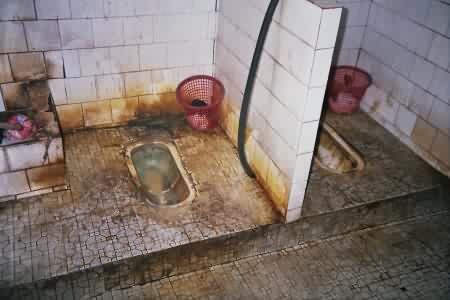
Above, a typical sight in Indian (or other developing country) toilets. The lack of running water and improper drainage means the toilets clog and don't work. Would you use this toilet?? Below, a woman sweeps raw sewage that is blocking a drain. Right next to it, runs a water pipeline. Both are cases of irresponsible design and engineering.


The "Aid World" (i.e. all the organizations/companies involved with the collection, distribution, and disbursement of international aid) desperately needs more holistic thinking. Without it, little sustainable change will happen.

Recently I was approached by a group of people looking to fund "sanitation schemes' in India. I sat them down to get a better idea of what exactly they were looking for. They wanted to "build toilets in Indian schools that educated the poor," they said. Besides that, I could "let my imagination go." I asked them what budget they had in mind. "Well, I've heard that you are a good person. So just write something that makes sense." (This was my mistake...I should have nailed down a number before moving on...a lesson I've learned since!!) But I was inspired. Finally someone who trusted my judgement!!

So I sat down and wrote something up. I thought about all the problems I had encountered in the field over the years -- random water pipes that either connected to nothing or a a dried up well, toilets that failed because they had no water access, and horrible sewage overflows from badly designed systems. These had taught me the importance of thinking holistically. If I ever got a chance, I had promised myself that I would design differently, more holistically.

The first thing I did was assume that the prototype school had to be in a village with good water access. Regardless of what people say, unless you've been brought up with them, dry or waterless toilets remain unused, particularly when you are dealing with uneducated people.

Then I designed the toilet. And I tripled the number to be built. What people don't realize is that few things in poor areas work. And when something works, the whole village or slum or community starts to rely on it. So even if the toilets were designed for the school, chances are that the whole village will start using them at some point. Better to design with that in mind, rather than have a war break out between the school authorities and the villagers (I have heard about these cases!), atleast until there is money to build toilets in the village proper. Besides, its not such a bad thing to give adults a reason to come to the school!!

The sewage had to go somewhere in a safe way. So I designed a very basic treatment system, that let grey water irrigate the prototypical kitchen garden that the school would have.

Then I designed the water system. A simple one that would incorporate a water filtration mechanism for drinking water (this involved electricity...but i would downsize to something more appropriate depending on local electricity and water conditions).

Thus, I had a good holistic system in place. I did a basic set of calculations and proudly marched over to hand the proposal into the folks I had spoken to. They took one look and turned me down flat.

"What is all this nonsense??" they snarled, "We just wanted to build some toilets. Why are you putting all this unnecessary stuff in?? I know how much building a toilet costs!! And this is too much." I tried explaining where I was coming from and why I had put in the extras. I even offered to cut my fees down. But they refused.

This isn't something new. Even as I speak, several thousands of "aid" toilets are being built around the world without a care to the local geographical conditions, or socio-economic conditions. It is enormously frustrating to be called up later, during a cholera outbreak or some other public health disaster and know why it was happening in the first place.

If we are to build better systems, build more holistically. Its more expensive in the short term, but will pay huge dividends in the future.

Tuesday, October 20, 2009

Question from a reader: Fixing water filtration in India


A simple sand and activated charcoal filter ($10-15) can filter hundreds of gallons of water simply and cheaply. But will this solve India's (bottled) water issues?? Read on... (photosource: bethechangeinc)


I got the following question in my inbox recently. Its becoming a question of increasing frequency, and I want to address it properly. Here's the "question" the reader wrote:

Last year, after a research expedition [on the effect of plastics on the environment]...we were giving talks and meeting with legislators along the way [in North America].

At one of our talks, a woman who had just returned from a long trip in India approached me, and said, "this is all great what you guys are doing to educate people, BUT there are much larger problems with plastic bottles and waste overseas". She told me that due to poor sanitation, in some areas she'd been in, people had no choice but to drink out of plastic bottles, and lacked the infrastructure to deal with them.

Which made me wonder if bringing water filtration systems to India might make a difference, albeit small.... for peanuts here ($500-$1000), an entire school can have clean water.

I've never been to India, but would be interested to hear your thoughts. Perhaps we might try to raise money for a few filters, to start with...

Here was my response:

I agree with the bottled water issue. As much as I detest bottled water, I find that when I'm in the developing world for very short bursts (where I don't have the time to purge my system and adapt) and need reliable, safe water quickly, I rely on bottled water (note: I try to drink tea, boiled water, other boiled beverages or soups for the most part, and only eat fresh, cooked food. Bottled water is a substitute when I can't find these or its simply too hot!). Amongst poor communities, plastic bottles are a huge commodity. Recycling goes on in full, plus the thicker, better bottles are used as water bottles or to store other liquids. They use these for several reasons -- convenience, cost (free to find, recyclable when they are done, easy to replace), how light it is, how sturdy it is, its lack of brittleness, etc. And yes...often they have no other choice.

Water filters are available in abundance in most of the developing world, particularly in non-disaster zones. India has a lot of indigenous water filters that do a very good job...most selling for around $50-$100. Most middle, upper, even poorer class Indians have them installed in their houses, though the best and most effective need access to electricity (they are RO systems). If you really want, you can build one using sand and a large bucket (or see diagram above). This is how most wastewater is treated in the US, though on a much larger scale. Clear water combined with some bleach dosing (aka chlorine disinfection), should render perfectly safe and drinkable water, and all for less than $10.

Probably best of all, there is always the option of boiling...the problem with this is that its very energy intensive and if you use wood/charcoal/kerosene, its simply too expensive. (I tend to boil my water usually in the developing world, except when i've run out of my supply and then use the water i find either at a tea shop or i buy bottled water).

Sometimes its not the filtration that's the problem....its the sourcing of clean water, the collection, the transportation, and the storage of water that are the biggest issues. Outside of the sourcing issues, plastic generally fills these voids.

Of course, for problems like arsenic, fluoride, salinity, etc, where you need more advanced cleaning, or where the water is extremely turbid (cloudy or visibly dirty), it becomes a different issue. These are very regional issues, and generally you can figure out what the biggest water problems in that area are by visiting the NGOs, doctors or govt public health agencies in that area. If its pathogen-related (which is the majority of water quality issues), then generally some proper boiling or filtration/disinfection will quell the problem. But other issues need more specialized solutions.

Finally, I'm not a huge fan of transplanted filters or other mechanisms. Filters from here are not made to withstand water or field conditions there. Expensive systems have a short shelflife, then like every other good transplant, they wither and die. This is partially because there is no one to do regular operation and maintenance, or who has been trained properly to fix even the smallest problems. A COMMON problem is letting untrained hands take over the operation of a technology. Their curiosity gets the better of them, and the technology is quickly rendered useless. Replacement parts are hard to find and buy, and the issue of untrained hands repeats itself. Always look for indigenous units, you are much more likely to have success in terms of adoption, operation/maintenance, and replacement if necessary.

These are my immediate thoughts on the subject. I'm always happy to discuss this further with you...

Thoughts anyone??

Thursday, September 17, 2009

Letter from the Field: South Sudan

Instead of my usual babbling, I thought you would enjoy an actual letter from the field.

Mike is a friend and fellow water-sanitation engineer. He's been working on international development projects for about 5 years now, regularly traveling to some of the most volatile parts of the world for his work. This is a recent letter he sent while on duty in Juba, South Sudan. His letter is published here in its entirety with his permission.
________

Before there was Lisa, there were escapades in Central Asia and East Africa and South Asia and Melanesia.  Before that, Melbourne, city I love.  But before all those things there was Haroun, the embodiment of a place that had caught my heart.  Once upon a steamy summer evening in Atlanta, after I had helped Haroun’s family move into their new apartment, we went next door to join four other families.  The people inside, black as night with tribal markings sketched into their foreheads, stood silently in the corners of the room, in the way that refugees learn to do. We broke bread.  The room was filled with melodies of praise sung by voices seeped in red soil and baked by an African sun.  I stood transfixed.  “You will make it to southern Sudan someday,” Haroun leaned over and whispered to me.  Perhaps Haroun was a prophet. 


What’s it like to finally arrive in a place that you’ve been interested in for over a decade? 


Well for one, it’s being towered over by a tall soldier who’s ensuring that you are deleting the photo you just took as you walked across the tarmac from the plane. 


“I’m sorry.  It’s my first time in Sudan and I wanted to get a picture of arriving,” I say as I press the delete button at the bottom right of the camera.  The soldier stoically stares at the next photo that appears on the screen.  It’s a photo I took while Lisa and I were driving down the LA freeway to the airport.  “That’s from Los Angeles, not here,” I assure him.   He nods and motions me towards arrivals. 


Turns out that the airport isn’t the only place in Juba where uniformed men disapprove of cameras toted by foreigners.  The streets, the marketplaces, anywhere near the parliament building, and especially crossing the Juba Bridge, the only crossing of the Nile for over 500 kilometers to the north or south.  But if you want to photograph the Juba Bridge, you just go over to the fancy restaurant with its white polyester tablecloths situated on the bank of the river 250 meters downstream from the bridge.  Order and coke and take as many photos as you like. 


I’ve come to Juba to do an evaluation of the USAID funded Juba urban WASH (water, sanitation and hygiene) project.  Before I left I was under the impression that I’d be walking around with groups of project staff doing household surveys and leading focus group discussions and inspecting construction quality of toilets.  Before I left I was also under the impression that I’d be evaluating the first ever piped water network in Juba’s history.  I was wrong, on both accounts.  Turns out that back in the 1920s when the British were still the colonial power, they installed over 50 kilometers of pipes in what was, at the time, quite a remote outpost town.  The water system hasn’t been upgraded or maintained during the past 60 or so years that Sudan has been embroiled in its particularly vicious civil war. 


As turns out, USAID also didn’t want me to lead teams of Sudanese staff traipsing around Juba interrogating people about their toilet use and handwashing practices.  I came to realize on my first afternoon in Juba that my job was to interview a lot of government officials, to examine the policy framework of the new-ish, quasi-autonomous government of South Sudan, and to provide strategic recommendations as to how USAID should further invest in urban WASH in South Sudan (and indirectly, about how to assist the quasi-autonomous nascent government).


Juba 2009 has whispers of Kabul 2003.  Bustling, hopeful.  On the streets craftsmen are making furniture, welders are fusing iron gates.  People are buying and selling.  Music emanates from bamboo-walled restaurant shacks.  Motorcycles zip about.  Mobile phones charging at wooden stands.  All in a city where there’s no electricity grid.  Juba’s booming. 


At newly opened restaurants where Kenyan and Ugandan wait staff serve cold drinks and imported food to the throngs of foreign businessmen and aid workers, the faces from Europe and North America sit at broad tables with their compatriots from East Africa.  They talk of low capacity in South Sudan, lower than anywhere else they’ve worked.  Of the restlessness of the population, since benefits from the peace dividend have turned out to be lower than what was expected.  The elephant in the corner of the room is the referendum that’s scheduled to occur in about 18 months.  According to the arrangements of the 2005 peace agreement, South Sudan gets 6 years of autonomous rule and then there’s a referendum where southerners get to vote on secession.  Everyone expects an overwhelming yes vote from the population.  No one expects the government in Khartoum to allow it to happen, this being the same regime that has waged a repressive war against the south for as long as anyone can remember and then a few years ago decided to shift war efforts to a once unheard of part of Sudan called Darfur.  And just in case you were wondering, the oil fields are in South Sudan. 


The lodge where I’m staying is at the edge of the rapidly sprawling city.  It’s really nice accommodation, especially for Juba standards.  A year and a half ago the population of Juba was around 250 thousand, there were 6 km of paved roads, and $100 a night would get you a canvas tent and a shared pit latrine.  Now there around 400 thousand in Juba, about 20 km of paved roads, and $150 a night gets you a private air conditioned hut inside a barbed wire fence containing one of the three pools in South Sudan.  In between the huts, the grounds are covered with portulacas.  In daytime the flowers open up, transforming the land into a carpet of purple.  As you walk around Juba, even in the areas where there isn’t any running water – much less swimming pools – you see that families have planted portulacas.  Patches of hopeful purple flowers in a sea of brown dust.  In Juba Arabic they’re called “sahb ahkeer,” which means “flower of sunrise.”  I hope it’s sunrise for Juba; for South Sudan.


“I hope your son is able to return to South Sudan someday,” I told Haroun a decade ago, when last I saw him. 


I’m still hoping. 


Love from South Sudan,

Mike

Thursday, April 30, 2009

A lesson in environmental law


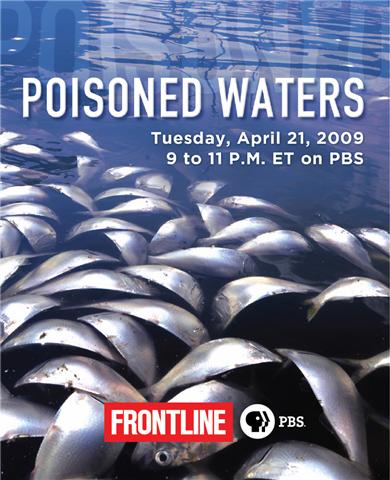
Frontline, a documentary series that discusses current affairs, recently did a brilliant documentary called Poisoned Waters (you can see it in full here), which outlines the U.S's long and difficult fight against pollution. It outlines what pushed the Clean Water Act (a landmark anti-pollution act) that forced polluters to become more responsible, the establishment of the EPA (Environmental Protection Agency - essentially our pollution control board), and much more.

If you want a history of environmental law in the United States, then DEFINITELY watch it.

But probably most importantly, people from the developing world NEED to watch it too, because this tough regulation on polluters in the US is what started the push to outsource these pollutants and polluting industries onto emerging and third world economies. Also, the developing world has the chance to step up and not make the mistakes, we in the first world have already made.

I think that's the key. Developing and emerging economies are at a point of bypassing, surpassing, and innovating beyond the first world to be EVEN better. Rather than complain about what they don't have, they should take the chance to challenge themselves to learn from our mistakes and do it even better.

Here is a sneak peek:

Wednesday, April 15, 2009

Cool job studying water footprints

I don't usually post jobs here, but I thought this one was super cool. If I didn't have a contract already, I probably would have jumped on this. The idea of a "water footprint" is fascinating to me. Its essentially studying the overall water consumption of a process from cradle to cradle (or to grave, depending on your system of thinking); and then figuring out how and where you can cut down on water consumption.

-----
The International Finance Corporation (IFC) is seeking a senior water specialist/hydrologist to support IFC in the design and supervision of water footprinting pilots. The IFC (www.ifc.org) is the private sector investment arm of the World Bank Group. In 2008, IFC became a founding partner of the Water Footprint Network
( www.waterfootprint.org).

IFC now wishes to undertake Water Footprint pilots with selected IFC corporate agribusiness and mining clients in developing countries, initially focusing on India and Africa. The expert would be offered a part-time consultancy assignment with IFC, initially for up to 50 days, spread over 12 months. There is a strong likelihood of additional consulting work becoming available through the Water Footprint Network.

The announcement is posted at
http://www.waterfootprint.org/Reports/vacancies/Expert-for-IFC-water-footprinting.pdf

Deadline for applications: April 27.

Thursday, March 26, 2009

Tea Power

I just realized that my guest post on the power of tea has been up at change.org.

Wednesday, September 10, 2008

What's your Water Footprint??


What is your water footprint?? (photo courtesy: ~FreebirD~)

Al Gore has done phenomenal education of the public (atleast in the United States...which is huge!). He's made "carbon footprint" a regular term.

Now let's talk about water footprint. What's your water footprint?? Water is turning into the world's single most contentious issue, particularly in the developing world. Water Footprint.org is trying to raise public awareness around the issue. Calculate your water footprint here. Warning...its a slow website and not the best designed. But it gets the point across.

Thursday, August 28, 2008

What Water crisis?


We are in the middle of a water crisis. But what does that mean?? (photo courtesy: misteriddles)

I've been curious about what the "water crisis" means. Everyone's talking about it, but no one's actually quantified the problem. Is it a water supply problem? Is it lack of accessibility to water? Is it lack of technology development? Is it increasing pollution??

One might say all (though I would like to argue that tech development is not one of them). But what's the biggest one??

BusinessPundit
sat Aguanomics blogger and water economist David Zetland down to sort out the same issue. Check out the interview here (portion follows...)

We’re in a water crisis.


Before I talked to economist and creator of Aguanomics David Zetland, those two words–water + crisis—made me scratch my head.

I’ve visited developing countries with water problems in the past. In many of those places, water trucks refill tanks located on the tops of buildings, and consumers have to haul their daily dihydrogen monoxide home in buckets. Here in the States, however, there’s plenty of water flowing from our taps. All the time.

According to Zetland, that illusion of plenty–endless water flowing from our taps–is part of the problem.

Business Pundit interviewed Zetland, who was recently been featured in Forbes and on Fox Business News, to get a primer on the water crisis—and how to solve it. Below are notes from the interview.

[READ MORE]


Monday, August 25, 2008

The Water Problem

This is a debate that could take ages to figure out - what do we do about our water and who is responsible?? A controversial documentary "Flow" is on its way out. See the trailer below. Also see Water Economist David Zetland's response. He blogs on it twice.

I am torn between the two points of view.

(I am a regular reader of David's blog and have tremendous respect for his opinions. But, like every economist, he needs a bit of practicality to his theories. I honestly think that if he worked with an engineer and urban planner (who added practicality to his points of view), we could get some seriously robust water infrastructure churned out...rather than it just being a bunch of talk. Get out there David!!)

Friday, May 2, 2008

An Update on the Aquaduct

A few weeks ago, I blogged about/reviewed a technology called The Aquaduct. As stated in that post, I had emailed the team a few questions that I couldn't find answers to. It took them three weeks to respond, and they sent me a generic answer after all of that. But apparently, they've started a blog with the first post answering a lot of my questions, including how they came up with their design, the type of filter they used, the cost of their product, and where they were heading with it.

Frankly I'm a bit disappointed with the vagueness of their answers. Still it atleast scratches the surface...


Wednesday, April 23, 2008

Greened Out

Its the day after Earth Day. I never thought I'd say this, but I'm officially "greened-out." I got so bombarded with green posts, emails, lectures, magazines and billboards about saving water and food and animals and the earth, that I decided to save my own sanity (and yours) and not post much. I had originally composed two posts on water conservation, but I hope you already know that you should not waste water. If not, let me just say...please conserve water.

Another by-product of this green-out is that I am depressed...I saw so many pictures (even a hip hop video) of how depressing the world is that I had to escape.

I had to do something un-green and get my adrenaline pumping. So I went into my backyard and killed all the green weeds I could find, and then watched Monsters Inc (which has a lot of blue monsters, if you ignore Mike Wazowski). I feel much better this morning.

I still love earth. And so I leave you with some Colbert:

Friday, April 18, 2008

Water Technology: The Hippo Roller


Women in South Africa use the Hippo Roller to transport and store water (photo: Hippo Roller.org).

Technology Name: HIPPO ROLLER


Description:
In a nutshell, the Hippo Roller (HR) is a water transporter and storage unit, designed in South Africa.

The HR organizational website has an extensive description about their technology. I'll just paraphrase it for everyone's benefit:

HR is a 20 gallon (90L) polyethylene water drum designed to roll on the ground rather than being carried on the head. The polyethylene is UV stabilized and sturdy enough to withstand every kind of rural condition. To aid input and output of the liquid, as well as cleaning of the drum, there is a large screw-on cap. A clip-on steel handle is used to push the drum around.

HR Specifications:
Year of design: 1996 (I think)
Distribution: 25,000 have been distributed as of May, 2007 (almost all donated)
Size: 20 gallon (90L) drum
Material: UV stabilized, sturdy polyethylene
Features: Steel clip-on handle, Large screw cap (135mm/5.3" diameter)
Cost: US$90 manufacturing + US$10 delivery (the drum is produced in South Africa; delivery costs are in-country as well)

Apparently, the design allows five times the regular amount of water to be carried with a ninth of the force, when compared with the traditional method of carrying water on the head. (If you really want the technical version, the earth balances out a large part of the water+drum weight, leaving only a fraction of the weight and friction for the pusher).

HR also comes with a Hippo Food Security System in place aimed at an average sized family of six. It includes:
  • A 210 liter drum for the irrigation system and a 90 liter Hippo Water Roller used for topping up the reservoir.
  • 8 x 6 meter drip lines are also included which cover up to 50 square meters of land.
  • Tools and instructions and a starter pack of seeds for both the summer and the winter.
  • Further training is available if needed.
At the moment, HR is made only in one size.


The Hippo Drum, a closer look (photo source: Project H Design)

My review:
I was browsing through Project H Design's website recently and saw this technology being featured. The H team ended up funding a large project in South Africa in March 2008, which is covered here.

The good:
I've carried my share of water and I can tell you that it is a real pain in the neck (no pun intended). So HR is addressing a real and very important problem.

The concept is simple, replicable, and it works for the processes that it was built for, i.e. storage and transport. The drum has a sturdy construction that can go over all kinds of terrain. It really takes pressure off the women, and she can carry an entire day's water needs in one visit...very efficient!

The what:
I don't think the pushing mechanism works so well if the drum is anything less than full. I've had to roll around half empty barrels on flat earth and uphill (downhill isn't so bad), and the darn thing kept sloshing around. Sometimes going uphill became a battle because the momentum from the sloshing worked against me, and my toes were sore from acting as stoppers!

I'm also not clear on how you fill water from a shallow pool, like if the depth of the pool is less than the diameter of the drum. I guess you have to carry a mug or cup of some sort and scoop the water in. That's the disadvantage of having a big drum as opposed to a 20L jerry can that can be flipped about conveniently.

Another down-side of the mechanism (though not that big a downside) is that sedimentation is slowed down in this case. If you have particularly turbid (muddy) water, then shaking it around just makes the problem worse (carrying water on the head aids sedimentation, making it easy to decant the sample as soon as the bearer gets home).

And what is with the cost?? $90 for a drum?? I understand that things are far more expensive to produce in-country and that there is a social cost to this (hire local unskilled workers, train them, build an industry from scratch, etc). But come on!! You'll be relying on donations for the rest of your life!! (actually is this what is possibly happening with Playpump as well??) I mean...I can clean out one of the ubiquitous steel drums that they have there, have a welder fix me a clip-on (or even permanent) steel handle and sell that for $5 (which is still an unearthly sum, but more consumable and scalable!!). In fact, if I was in South Africa, I'd find a smart, enterprising fellow and invest in him to do this. Trust me, he'd outsell HR and build up a slew of copycats.

Actually this has got me started on a major pet-peeve. Social technology organizations NEED to start thinking about the bottom line. The main goal of ANY organization is to make people's lives easier, so if your technology is really helpful but is not reaching the most number of people it can, you HAVE to ask why and how you can change that. It HAS TO BE SCALABLE. HR is an easily scalable technology, but what is holding it back is the cost. So do what you can to bring down the cost, then use the profits to improve the product (or increase your product line-up) and your marketing model. Don't start with an overpriced technology, you are killing your own success.

And here's another, related pet-peeve...let the poor buy their stuff. STOP giving this away to them for free. It limits scalability and kills the sense of ownership of the owner, which is REALLY important. I have spent considerable time researching the best practices of social entrepreneurs, and I was surprised by how much charity killed the sense of ownership and pride that the consumers had for a particular product. Generally, a technology that required some investment got more respect, was more valued, cared for and gave the owner a great sense of pride. Charity is necessary sometimes, but if you can help it, let the consumer have some pride.


Variations I would suggest:

1. Reduce the cost. $90 is really insane for a plastic drum with a handle. Go for a more affordable, simpler design, and upgrade to the better design as you make profits (which will come with mass production).

2. Each drum has valuable advertising space (even for social messages) that isn't being used. Maybe each woman can sell this space and get her drum entirely subsidized.

3. why not incorporate a simple cloth filter and chlorination mechanism. The water will get basic filtration and be thoroughly disinfected (thanks to the mixing) by the time it reaches home.

4. If you expand the opening and add an extra contraption, the rolling mechanism can make for a spectacular washing machine.

5. HR can also be used as cement/concrete mixer or a leveller (making pathways level). Maybe these women can make extra money by working on a construction site.

6. A kind of line that keeps the lid attached to the drum (rather than it floating away in the river!) would be nice.

7. Another clip on can be using the rotational motion to grind mill flower or just storing the energy as electricity in a battery (but that has its own implications!).

Other reviews/information:
http://www.design21sdn.com/feature/21
http://www.notcot.com/archives/2005/05/design_to_impro.php
http://www.plusonewater.ca/en/FAQ.php#Hippo%20Roller
http://projecthdesign.com/2008/04/13/hippo-rollers-delivered-to-kgautswane/
http://www.treehugger.com/files/2006/12/the_hippo_water.php
http://poverty.suite101.com/article.cfm/invention_for_more_water_in_africa
http://en.wikipedia.org/wiki/Hippo_water_roller
http://www.typepad.com/t/trackback/462659/3401481

Water Exercise: Water-Use Calculator


Calculating your water usage is an important step to increasing the availability of water for others. (photo source: Sneske@gastronomic Fight Club)

Unilever and Zerofootprint.net have teamed up to come up with a one-minute water calculator. Answer a few questions and you'll know how much water a year you are using per year. You can also see what activities are your biggest "water guzzlers" and what to do about them.

I almost highlighted this as a technology, as I think that the only way to increase availability of water resources in other parts is to decrease their use in water guzzling nations like the United States, Canada, and Europe. And anything that makes us aware of our wastage works for me.

What few people realize is that there is only a finite amount of water (and drinking water) on this earth. With our continuous wastage and pollution, this precious resource is slowly ebbing away. Our hogging of water is taking away water from other areas, ones that are far more desperate than us, and where a liter of water means the difference between life and death.

Also, once you are done calculating your water usage, keep in mind that the World Health Organization (WHO) mandates a minimum of 20L (5.29 gal) of water per person per day, which means about 7300L (1931 gallons) per person per year. The reality at the moment is that most of the poor in the developing world live on far less than that.

Thursday, April 17, 2008

Water Technology: The Playpump


Children ride around on a Playpump in South Africa that provides water to their school! (photo: project H Design)

Technology Name: PLAYPUMP


Description:
In a nutshell, the Playpump is quite simply a pump. It uses energy from a merry-go-round to pump groundwater into an overhead water tank.

Playpump is the brainchild of Trevor Field, a former marketing/advertising exec. He says he saw children playing around one day in South Africa and wondered if he could harness that energy to pump water. Now children are encouraged to play so that they can bring water into the school!


The playpump really works that simply. Rotational movement from the merry-go-round(1) goes to pump clean water(2) from the ground into an overhead tank(4). Water from the tank then operates on gravity and is collected by tap in some convenient locations(6). The traditional ubiquitous tubewell (see photo) also operates on the same mechanism, only it uses an up-and-down motion rather than a circular motion. (photo source: Playpumps International)

Playpump won the World Bank Development Marketplace (DM) prize in 2000, and has grown by leaps and bounds since then. Trevor registered his organization as Playpumps International. You can visit their website here.

Here's how it works:


And here is National Geographic's recent piece on it:


My review:

I came across Playpumps International (PI) in 2005, when I got very involved with the Development Marketplace (DM) challenge. At that point I was consulting with some of the finalists to help make improve their business plans for the competition. I was struck by the simplicity and large impact that PI could potentially have. Essentially I was hooked.

The good:
Well, what's not to like about this?? Its a clean, simple concept that addresses a desperate need, and it really works.

I also love PI's total sustainable business concept. All parts are manufactured locally. They hire and train local help, and they generate revenues from advertising on their water tanks. They go a step further as well, in that all their advertising must include HIV/AIDS prevention messages or other such health-related messages. That's a really sustainable

The what:
To be honest, I don't know if there is a "what" for this project. I can't quite see a flaw in the technology. I've heard complaints from some organizations that the concept isn't working as well as PI advertises, but how true that is or why that is, I'm not sure. I'm hoping some reader can shed light on this.

I'll be honest though, I'm not crazy about their merry-go-round design. I think that can definitely be done better, and they can probably set up an entire playground while they are at it. But that's a different story.

Variations I would suggest:
Not much. I just think the merry-go-rounds can be better designed. But more importantly:

1. How about getting solar panels on there and making some energy for electricity (and also using the kids leftover energy for the same!) in the school...


Other reviews/information:
World Bank DM Press: Playpump
PBS Frontline/World's story on Playpumps International

Case Foundation's Writeup on PI
http://www.nextbillion.net/activitycapsule/1917

Wednesday, April 16, 2008

Water Technology: The Rainpod


The Rainpod! (photo: hotchoz.com)

Technology Name: RAINPOD


Description:
In a nutshell, the Rainpod is a rainwater collection, storage and distribution unit, all in one.

On hotchoz.com, Designer David L'Hôte says
"People usually water their plants and garden with tapwater although rainwater is free...Rainpod is a standalone rain collector. Its three legs are made of local wood trunks which makes each unit unique and reduces transportation impact. Its high placed tank delivers rainwater under pressure for easy watering, thanks to gravity."
It comes in various sizes and layouts like below (source: Mocoloco).


It works simply. The pod-like structure is the water storage unit, and incorporates little drain areas to let collected water filter in. The catchment area on top can be opened or closed as you need. The little hose on the bottom is exactly that...it drains water from the storage unit using gravity.

The pod stands taller than the average adult and consequently uses gravity to move the water.

My review:
I came across the UFO-like Rainpod a few days back when browsing around the internet. In the beginning, I didn't get what it was. But as I thought about it more, I really liked the idea. It looked like it would work really well in a developing country. Why?

The good:
Well, it is cute or atleast cuter than the typical rainwater system currently in use. It might generate buzz and encourage use of the system (maybe 3-4 villagers can buy a larger system and share it between them). But aesthetics are never the number one point for buying something, particularly in the BoP population. So let's put that aside.

I like the size variability, which gives a poorer customer options of size and payments. I love the all-in-one design, which makes it possible for someone to even start a rental business with these pods (want some water?? Rent a pod!). Its essentially transportable, mobile, and easy to set up...all of which expand the possibilities of who, where, and when the Rainpod can be used. It can be used on urban rooftops and in rural areas. Its a complete system!

I really like the folding mechanism of the catchment. During the rainy season it takes more space; after it takes much less. But more importantly, because the catchment is easily folded in, it stays protected and relatively clean, while adding to the protection of the storage unit from contamination.

The hose at the very bottom means that ALL the water will get used up and drained out (water and pod can be regularly flushed out easily). And finally, because it stands taller than the average man, the tank is not necessarily in anyone's way and it harnesses gravity for distribution (you can even stand under the hose and shower!).

I just really liked the overall design of this unit. It included a lot of elements that few people think about, and although it was clearly designed for the western world, I think it will work very well in the developing world.

(oh, and the outer pod surface area is good advertising space. Get a couple of ads on there, and the pod owner can make his money back on the pod! yes...my head works very well!)

The what: I'm not sure how easy it is to clean it and what the mechanisms involved to do so are. And I really have no idea what the cost of the whole Rainpod or its replacement parts are (operation and maintenance costs are critical for BoP). I don't even know what material it is made of. I looked everywhere for these bits of information but couldn't find any.* Its still a prototype thats hunting for a manufacturer (so this information is a little time away). But it is cool. And by adding a few amenities (see under variations), Rainpod could really be a superstar.

Variations I would suggest:

1. Smaller wall or roof mountable units would be awesome, so that urban dwellers can claim its benefits as well, particularly if you are in a multiple house dwelling with no roof access.

2. An optional clip on/off filtration system can mean making the water instantly drinkable.

3. Adding a solar element might turn it into a solar water heater, or during the summer, when it doesn't rain, the tank can have optional solar panels or metallic parabolas to generate power. Maybe you can even harness the gravity drip energy of the water and have a mini-hydropower generator.

4. Increase the catchment space (by launching the catchment material out further) or incorporate ways for house gutters or other existing systems to work with the pod.


*I did find one blogsite that said the Rainpod came with an automatic timer and irrigation system. It carried upto 800 liters (212 gallons) of water was retailing for GBP 698 (USD 1378). This site had no pictures or description to really distinguish the pod I'm talking about, and since I can't find their reference (and these are professional journalists!), I'm assuming that the information is still at large.

Other reviews/information:
http://mocoloco.com/archives/005348.php
http://www.treehugger.com/files/2008/04/rainpod-kicks-butt.php
http://www.ecofriend.org/entry/rainpod-a-beautiful-way-to-use-every-drop-of-rain-to-water-your-garden
http://www.materialicio.us/2008/04/08/rainpod/
http://dvice.com/archives/2008/04/rainpod_collect.php
All about Rainwater Harvesting

Monday, April 14, 2008

Water Technology: The Aquaduct


The IDEO team pose with their winning technology (photo: examiner)

Technology Name: AQUADUCT


Description:
In a nutshell, the Aquaduct a pedal powered water transportation and filtration system.

Aquaduct was designed by a team of IDEO folks in response to the Innovate or Die competition 2007, sponsored by Google and Specialized Bicycles. It placed first. The rules were simple:
  • Invent an unheard of, unprecedented pedal-powered machine, build it and film it. Just make sure that your innovation has human pedal power as its original source.
  • You may either ride solo or build with a team of up to five people.
  • Individual entrants (or the team contact) must be registered members of YouTube at the time of entry, be at least 18 or older and be residents of the U.S., Canada, France, Ireland, Italy, Japan, The Netherlands, Poland, Spain or the U.K.
Here's the basic layout and design of it:


My review:
The Aquaduct basically helps with transportation, filtration, and storage, (and disinfection?? need to check on this).

The good: It uses bicycles (with parts that can be found in even the remote parts of any developing country) and human power (probably the only thing they can count on in poor areas); it looks cute, and combines several different water processes into one unit. The filter is just representative of other more locally available filtering systems that we can find. I love the fact that the water is covered at all times, which keeps it from being contaminated further. And I love the pedal-powered pump.

The what: Ummm...bicycles being used to transport water or anything else in developing countries are not new. Infact bicycles are the first transportation vehicles that a poor person will invest in. And they've been using bicycles to transport water and everything else for centuries. So why would anyone invest in this tricked out tricycle that carries only water??

And cost-wise, bicycles are luxury items to being with, in many of these parts. So you have to make it functional. Essentially, think about the cost and then double the amenities that come with it or it will fail.


Bicycles are crucial transportation for the poor, and a luxury. On the left, Ugandan boys carry jerry cans of water back home [1]; on the right, an Indian boy carries cans of water, petrol and a friend on a tricycle [2]. If Aquaduct wants to succeed, it must expand its functionality.

Variations I would suggest:

1. Most poor people I've gone water hunting with, carry plastic or clay pots (the clay keeps the water cold), or large 20 gallon plastic jugs (aka jerry cans). The Aquaduct should actually include areas to load existing water jugs and filter into existing water jugs, not new ones that you sell with the tricycle.

2. Make the rear storage unit a "clip-on" so that they can take that thing out and carry other things when they need to.

3. I love the peristatic pump. Is there any way you can design it so that the pedal-power can be used to pump water directly from the ground? or transfer to power other things?? Poor people WON'T invest in this unless it can serve multiple purposes.

[1]: Source: Staffordshire Learning Network
[2]:
Source: People's Daily Online

Other reviews/information:
http://www.ohgizmo.com/2008/03/12/aquaduct-is-a-pedal-powered-water-purifier/
http://urlgreyhot.com/personal/weblog/innovate_or_die_winner_aquaduct
http://www.dezeen.com/2008/03/11/aquaduct-by-ideo/
http://mellowvelo.blogspot.com/2008/01/aquaduct-mobile-filtration-vehicle.html
The very uninformative Innovate or Die website
The inspiration behind Innovate or Die:

Sunday, April 13, 2008

Estamos Founder (who focuses on clean water and eco-sanitation) wins Goldman Prize


Feliciano dos Santos talks to a rural community about clean water and sanitation (Photo: John Antonelli for the Goldman Prize)

Today, I was reading about the winners of the Goldman Prize, which is...
...the world's largest prize honoring grassroots environmentalists... Founded in 1990 by Richard and Rhoda Goldman, the Goldman Environmental Prize annually awards US$150,000 to environmental heroes from each of the world's six inhabited continental regions.
Turns out one of the 2008 winners is Feliciano dos Santos, a Mozambiquan musician who has spent the past 10 years providing and promoting safe water and ecological sanitation to rural communities in Mozambique through an organization he cofounded called Estamos. In 2005, I had the opportunity to work extensively with Estamos in Maputo doing wat-san work. They were a wonderful community-based organization and had tremendous trust within the communities they worked in.

Feliciano is cool for more reasons. He has also started a musical band called Massakos, and he uses the music to promote hygienic practices, clean water, and sanitation in the communities. The music is catchy, and his number one hit "Wash Your Hands" has even become an international hit! He has now signed with UK-based Poo Productions (gotta love the name!) which promotes bands and films that also focus on awareness of water and sanitation issues in the developing world.

The websites are all great, with documentaries and music for you to check out. And if you like the music, buy it! Proceeds from music sales go to support Estamos and other wat-san projects for the poor.
Also, BBC recently did a write-up on him, which is also very good.