Showing posts with label toilets. Show all posts

Monday, July 19, 2010

Links I liked

I'm in the middle of reading through my blogroll after a very long time. I've just been inundated with work, and am finally able to make the time to catch up on my reading. Here are some of the best of the links I've seen so far:

1. Interesting Q&A session with popular development economist and author of "The End of Poverty", Prof Jeffrey Sachs

2. Diagnostics continue to be the bottleneck for most healthcare in the developing world. Therefore, it shouldn't be surprising that this particular cheap diagnostic test out of Vietnam is causing ripples.

3. Around a fifth of global science papers are now freely available online, a study finds, with Latin America and India leading the pack!

4. Ask a garbologist questions. Fascinating potential discussion and amusing writeup.

5. Belgium is considering resomation...would you want to be resomated after you die??

6. How "easy" do you think this award-winning "easy latrine" is??

7. Alaskan water being shipped to India...(seriously!)


Monday, July 12, 2010

The Sanitation Crisis explored by Current TV's Adam Yamaguchi


Adam Yamaguchi on site in India (http://i2.crtcdn.net/images/ed/2010/03/08/082741.jpg)

Sanitation crisis documentary

Vanguard correspondent Adam Yamaguchi travels to India, Singapore and Indonesia to understand why people don't use toilets and what's being done to end the practice of open defecation.

An estimated 2.6 billion people, about 40% of the world's population, have no access to toilets and defecate anywhere they can. As a result, more than 2 million people -- including 1.5 million children -- die from complications of chronic diarrhea.

When human waste isn't contained or flushed down the toilet, it's everywhere -- in streets, open fields and, most dangerously, in the very water people drink. Adam investigates how countries are trying to solve an epidemic that few people want to talk about -- the world's toilet crisis.

"Vanguard," airing weekly on Current TV Wednesdays at 10/9c, is a no-limits documentary series whose award-winning correspondents put themselves in extraordinary situations to immerse viewers in global issues that have a large social significance. Unlike sound-bite driven reporting, the show's correspondents, Adam Yamaguchi, Kaj Larsen, Christof Putzel and Mariana van Zeller, serve as trusted guides who take viewers on in-depth real life adventures in pursuit of some of the world's most important stories.

http://current.com/shows/vanguard/92482205_the-worlds-toilet-crisis.htm

Saturday, January 30, 2010

The Need for Well-Rounded, Holistic Thinking


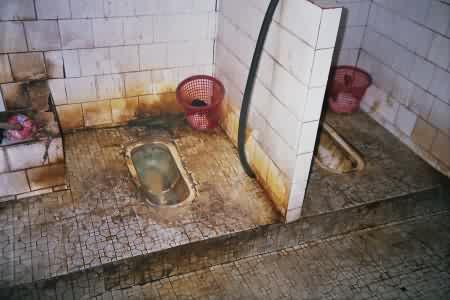
Above, a typical sight in Indian (or other developing country) toilets. The lack of running water and improper drainage means the toilets clog and don't work. Would you use this toilet?? Below, a woman sweeps raw sewage that is blocking a drain. Right next to it, runs a water pipeline. Both are cases of irresponsible design and engineering.


The "Aid World" (i.e. all the organizations/companies involved with the collection, distribution, and disbursement of international aid) desperately needs more holistic thinking. Without it, little sustainable change will happen.

Recently I was approached by a group of people looking to fund "sanitation schemes' in India. I sat them down to get a better idea of what exactly they were looking for. They wanted to "build toilets in Indian schools that educated the poor," they said. Besides that, I could "let my imagination go." I asked them what budget they had in mind. "Well, I've heard that you are a good person. So just write something that makes sense." (This was my mistake...I should have nailed down a number before moving on...a lesson I've learned since!!) But I was inspired. Finally someone who trusted my judgement!!

So I sat down and wrote something up. I thought about all the problems I had encountered in the field over the years -- random water pipes that either connected to nothing or a a dried up well, toilets that failed because they had no water access, and horrible sewage overflows from badly designed systems. These had taught me the importance of thinking holistically. If I ever got a chance, I had promised myself that I would design differently, more holistically.

The first thing I did was assume that the prototype school had to be in a village with good water access. Regardless of what people say, unless you've been brought up with them, dry or waterless toilets remain unused, particularly when you are dealing with uneducated people.

Then I designed the toilet. And I tripled the number to be built. What people don't realize is that few things in poor areas work. And when something works, the whole village or slum or community starts to rely on it. So even if the toilets were designed for the school, chances are that the whole village will start using them at some point. Better to design with that in mind, rather than have a war break out between the school authorities and the villagers (I have heard about these cases!), atleast until there is money to build toilets in the village proper. Besides, its not such a bad thing to give adults a reason to come to the school!!

The sewage had to go somewhere in a safe way. So I designed a very basic treatment system, that let grey water irrigate the prototypical kitchen garden that the school would have.

Then I designed the water system. A simple one that would incorporate a water filtration mechanism for drinking water (this involved electricity...but i would downsize to something more appropriate depending on local electricity and water conditions).

Thus, I had a good holistic system in place. I did a basic set of calculations and proudly marched over to hand the proposal into the folks I had spoken to. They took one look and turned me down flat.

"What is all this nonsense??" they snarled, "We just wanted to build some toilets. Why are you putting all this unnecessary stuff in?? I know how much building a toilet costs!! And this is too much." I tried explaining where I was coming from and why I had put in the extras. I even offered to cut my fees down. But they refused.

This isn't something new. Even as I speak, several thousands of "aid" toilets are being built around the world without a care to the local geographical conditions, or socio-economic conditions. It is enormously frustrating to be called up later, during a cholera outbreak or some other public health disaster and know why it was happening in the first place.

If we are to build better systems, build more holistically. Its more expensive in the short term, but will pay huge dividends in the future.

Friday, July 10, 2009

Links I liked

1. If you've ever been unhappy at work and considering quitting, read this post. It also has the best resignation letter ever.

2. Being a geek myself (and sometimes described as "Vulcan", if you are a Trekkie), I'd highly recommend reading this bit on the top ten mistakes people make when managing geeks. In fact, its so popular (and sanctioned) that its been voluntarily translated into 10 different languages, including Persian and Danish

3. An award-winning toilet made from horse-dung. Would you use it?? I would! Truly amazing what good design mixed with decent engineering can do. Here's another example of good design, good idea, and good engineering.

4.  Love reading while taking a dump?? Here's an innovative new dual purpose toilet book...literally!

5. Do our things make us happy?? Happiness Objectified...a must read on a survey done. 

Tuesday, September 16, 2008

Building a composting tumbler

On the composting piece, here's a great video about how to build your own composting tumbler. I'm fairly certain you can use the same (assuming that you put enough biomass and ash/sawdust) for composting humanure.

Wednesday, August 27, 2008

Composting Toilets


But for the sign, would you know that this was a composting toilet?? (photo courtesy: SRU.edu)

Having covered waterless urinals, its time to talk about Composting Toilets. If animals can make manure, why can't we??

Actually we can. Make did a great write up on the subject, including several resources about human manure.

Like waterless urinals, it would be great to incorporate composting toilets. But the reality of the situation is that it probably won't happen. This is a classic case of sociological issues rather than technology issues. There are just TOO many psychological issues to contend with. I can't get friends of mine to stop drinking bottled water in the United States (where tap water quality is excellent), because they are worried about germs in the tap water...I have no hopes with the composting toilets. And these are all people with college degrees from good schools!!

But maybe it'll have to become like the Darfuri solar cookstoves, where there are strong negative incentives that force people to use the technology. If things got so bad in the U.S, maybe we'd start using solar cookstoves, or composting toilets to save the planet (well, more like save ourselves).

How a composting toilet works
.
Build a composting toilet for $25
Is Humanure safe?


Profile of one of the many composting toilet designs (photo: weblife.org)

Wednesday, August 13, 2008

Waterless Urinals


Kohler's line of waterless urinals (photo courtesy: Kohler.com)

You are probably cringing as I write this. I did too. Men's bathrooms smell bad enough with running water...imagine how bad it could be without water!

One of my biggest annoyances when I'm traveling through developing countries is the presence of the ubiquitous man-facing-the-wall-and-peeing-wherever-he-feels-like-it. Many guys suggest that my irritation comes from not being anatomically endowed to do it myself. I disagree. My irritation comes from the sheer inconsiderate and unsanitary nature of this behavior. Many developing countries have enough waste and sanitation problems without having to deal with issues like this.

But there are water problems and the smell from many urinals is often unbearable, so can waterless urinals really work?? Apparently so.

How do they work??


How a waterless urinal works (photo courtesy: wired.com)

http://greenlineblog.com/waterless-urinals-how-do-they-work/

Fascinating stuff. Apparently they require little maintenance, and no water; and still are odorless and sanitary. This makes it perfect for the developing world...as Falcon Waterfree Technologies has already shown by installing their line in the men's bathrooms at the Taj Mahal in India.

Here are some posts about waterless urinals:
No Flush Urinal
Waterless Urinal

Waterless Urinals already being used in Japanese Train Stations