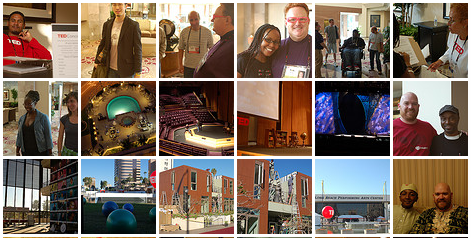
Showing posts sorted by relevance for query TED. Sort by date Show all posts

Monday, February 16, 2009

TED FAQ I: What was it like at TED??


Having successfully released more bugs on the audience and survived an interview with a cautiously "mac-ed out" Chris Anderson, Bill Gates shares laughs with Paul Allen and other original Microsofters over dinner at TED. Read what it was like to be there first-hand. Photo credit: Steve Jurvetson

I've been getting a LOT of questions about TED...what it was like to be there, what it meant to be there, and what were my favorite parts.

If you live in the Los Angeles area and are a friend (or want to be a friend!), I'm going to try and have something called a TEDx party (or maybe several of these, depending on how many show interest) at some point. Essentially, TEDx is where you do your own version of a TED-like event in your surroundings with your community. At mine, I want to show some videos and talk about my experiences, and answer the umpteen questions I've been getting from friends and family.

For those of you who can't make it, I'm going to try and recount some of my favorite moments to give you a glimpse of what it was like to be there among these wonderful geniuses of the world.

Here are some FAQ's to start:

Q. What is TED?

Ummm...Go to the website www.ted.com, watch some of the talks, get more information, and tell me what you think. In short, its the bestest and most kick@$$ conference man ever made.


Q. What was TED like??

It was an absolutely amazing experience. EVERYBODY at the conference has done something spectacular with themselves. I like to say that everyone is a somebody. The wisdom, the brainpower, the humility, the speakers, the audience, the musicians, the conversation there is unparalleled.

Here are some ways I would describe TED:

- an intense brain orgasm. Really...its very intense, just the right length, with amazing mental and emotional stimulation, and you remember it for life!

- the Academy Awards for Geeks. TED celebrates nerdiness in all its forms, by bringing together some of the greatest known and unknown nerds of the world under one roof, letting them give timed speeches under a spotlight, and giving them awesome goody bags just for coming.

- an intense booster shot of MIT goodness. Not sure if you've been to MIT, but its amazing. At all times, it contains some of the most hard-working, brilliant, well-rounded and humble people in the world working for the betterment of humanity. Its inspiration in a nutshell. At TED its the same, only there's good food at all times and you are generally a person of significant income (at MIT, both of these are sorely lacking). The exception to the income part are us poor Fellows!

- inspiration in a nutshell and nerd heroine. For those of you who watch the TEDtalks regularly, TED is addictive. You get incredible highs and lows and energy levels from it. You have withdrawal symptoms and anticipation symptoms. The time in TED is almost blissful. No wonder it sells out immediately and is the hardest ticket in town, inspite of its hefty pricetag!


Q. Are all the people nice there??

Well, that's a good question. Define "nice."

I'd say a great number of the people who have really done something are amazingly and surprisingly down-to-earth and approachable. If there is something that will totally disarm and put you in your place, it is this. Many won't even speak of their accomplishments and when they do in even the humblest terms, it blows you away.

Still, this is the real world, and there were a number of people running around with some sort of a "Bush Complex," named after the glorious ex-president of the U.S, people with enough means, fame, and brains to get to where they are (while everyone else wonders how!), who were there largely to network and talk down to people. If you are a Fellow, the "Bushes" avoid you almost entirely because you are worthless to them, except to allow them the chance to gloat.


Q. Did you encounter any "Bushes"?

No comment.

(Wondering what's a "Bush"?? read the last paragraph of the previous answer to "Are all the people nice there?")


Q. Did you see any famous people?? Who did you see??

Define "famous."

Like I said, its the world's best brains in all categories coming together. So most definitely yes, I saw a lot of people who I considered celebrities in their fields. TED has a strict confidential policy, so I can't mention a lot of people. But among many others, I trailed Seth Godin on a walk to lunch; counted Bill Gates' semi-gray hairs when I sat behind him; waved to Vice President Al Gore in the hallways; walked arm-in-arm with Regina Spektor; and hugged Ray Anderson for being such an inspiration. And yes, all these people sat with the rest of the audience on other days. There are no special places at TED.

more tomorrow... (and feel free to send me more questions!)

Friday, October 19, 2012

Singularity University's Graduate Student Program: FAQs


Over Summer 2012, I attended Singularity University's (SU) Graduate Studies Program (GSP12). I have been getting a NUMBER of questions about the experience, and I've answered many of them here. 

Please note that everything I've written is my opinion alone, not anyone else's. For any official definitions, information, etc, I urge you to visit the official SU Website


1. What is SU?

I would urge you to check their website for their official definition. But here's my take on it..."SU" or "Singularity University" was founded by Space Entrepreneur Peter Diamandis and Inventor/Entrepreneur Ray Kurzweil in 2009. Both are MIT grads, and famous for having innovated concepts, and creating unique companies (and in Kurzweil's case invented truly revolutionary products). Peter had read Ray's book titled "The Singularity is Near" and was so inspired by the concept that it moved him to create an education program around it. The result is SU.

What it is or what it does or what its goals are, is constantly evolving. It didn't seem clear to anyone I asked, including the staff and affiliates, who all gave me different answers/definitions while I was there. It is supposed to be a "non profit educational institute", but its MUCH more of a for-profit incubator. Or atleast that's what they are turning into

The easiest way I would define it is a guinea pig lab. The hope is that if you throw together a bunch of smart people from diverse backgrounds (in the same vein as IDEO, MIT or TED style), give them a lot of knowledge against the backdrop of Silicon Valley, you will get great output. 

They were in the process of filming a documentary about SU while I was there. Perhaps when that comes out, it will make more sense...

Here's a trailer of the GSP2010:


2. What is "The Singularity"??

For the unabridged version, read Ray Kurzweil's book "The Singularity is Near" or watch Documentaries "The Transcendent Man" or "The Singularity is Near." That might shed some light. 

Since I find the official definition(s) confusing, here's my take on it...it is a term coined by Kurzweil to indicate the point at which "machine intelligence will eclipse human intelligence." According to him, machine intelligence is growing at an exponential rate compared to human intelligence. At some point (I think he predicts 2045 or 2050), machines will meet and then become smarter than humans. That point of meeting is called "The Singularity."


3. Do you believe in "the Singularity"? Do they preach it at SU?

No I don't believe in the Singularity, nor do you need to in order to attend SU. Nor was I the only one who didn't believe in it. 

SU doesn't force any doctrine per se, except that there is an underlying theory of it floating around. Its why they teach you about "exponential technologies" (i.e. technologies that are improving at a rapid or 'exponential" rate). They do show you the Singularity Documentaries (see #2 above), and Ray Kurzweil delivers a few lectures on the subject. But Ray is a gentle soul...he doesn't force his doctrine or ways of thinking on anyone... 


4. How did you hear about SU? How did you come to attend it?

I heard about SU from Peter Diamandis (coFounder of SU) in 2008, while I was working for him at the XPRIZE Foundation. Then, it was still a concept that he was working hard to put together. It was a phenomenally enticing idea -- a summer of interdisciplinary education with game-changing faculty, and innovative people. 

Peter kept encouraging me to apply and attend the first year in 2009; and thenceforth with every class. But I was tied down. Fortunately, things came together (schedule-wise) this year; I applied, and was accepted.


5. Is SU a real University??

No. You have to be accredited, in order to be a University. 

SU has no full-time faculty and very limited full-time staff. SU is modeled after the International Space University (ISU) also cofounded by Peter Diamandis; both of which focus on interdisciplinary education, and supplement university education with practical elements like practitioner-based lectures, field visits, workshops, and projects. 

There is no campus per se. SU leases (I think) facilities on the NASA/Ames Base in Mountain View, CA; two small buildings -- one houses their operations and incubatorial activities, and the other classroom space in which the GSP (and other programs) are held. 


6. Have you attended International Space University (ISU)? Can you attend SU if you are an ISU alum?What's the difference between SU and ISU?

No, I have not attended ISU. You can attend both, without any issues, as there were classmates of mine who were ISU alums. 

The key difference (amongst many other things) between the two is their subject focus. ISU is focused entirely on Space and Space-related issues. SU is MUCH broader and generalistic. Although housed on a NASA base,  "Space" is only a SMALL part of the programs and activities.


7. What is the Graduate Studies Program or GSP?

Check here for the official definition, and goals. From what I have been told and experienced, it is their flagship education program that is spread out across 10 weeks in the summer at the NASA/Ames campus in Mountain View, CA. 

It brings together a diverse group of participants and over the course of the ten weeks exposes them to a variety of topics through practitioner lectures, workshops, site visits and group projects.

Check out a video of our class: 


8. Who generally attends GSP? What is the curriculum?

You can see some alum profiles and the curriculum on the website. Students are supposed to come from "everywhere" and be doing "everything". So essentially, anyone can apply to attend. Also, SU has generous scholarship packages to cover those who cannot afford the steep $25,000 fee. This makes it possible for anyone to attend once accepted.

The curriculum and the profile of the student class seems to change every year. It is supposed to be ten weeks (as of this year) of exposure to "exponential technologies" (an SU term for technology fields that are developing at a rapid rate); you are supposed to come away with an understanding of what the following fields are and where they are heading in the next 10-15 years: medicine, neuroscience, aerospace, Finance, Economics, Law, Policy, Ethics, Energy, Environment, Artificial Intelligence, Computing, Entrepreneurship, Biotechnology and Nanotechnology. 

During my program (summer 2012), Lectures/Classes ran for the first 7+ weeks, followed by Team Project work for 1+ weeks, and the last week was dedicated to "Launch" (a term for the last week meant to teach you how to take your team project and turn it into a company, if you so wish).

Your team project is supposed to take your knowledge of "exponential technologies" to address one of the Global Grand Challenges -- issues that supposedly affect the lives of 1 Billion people. These include energy, water, environment, space,  global health, poverty, education, and security.


9. What was your class composition like?

I don't remember the exact stats, but here's a close guesstimate: 80 students representing ~36 countries. The youngest participant was 21 (from Indonesia); the oldest was 52 (from Spain); the average age was around 28. ~10% of the class was from Asia + Sub Saharan Africa combined; North America had the largest representation, then Europe, and finally South America; the middle east was also minimally represented.


10. What's a typical day like?? Do you get weekends off?

Days are LONG, with 6-day work-weeks. Most weeks, you only get Sundays off. We did not even get Independence Day (July 4th) off. 

Of the 10 weeks, 7.5 weeks are "lecture weeks"; followed by 1.5 weeks of "group project"; ending with a "launch week." 

The "lecture weeks" (Week 1 thru Week 8.5) were the longest and least flexible (and least fun for me!). Class started at 9AM; and often went as late as 11PM. One day, it went until 1:30AM! The typical lecture day was broken up with meal breaks, and "wellness hour", though these were often eaten into to allow for unstructured student activity (discussion groups, hobby groups, etc). So you could easily go 18 hours without much of a break. Skipping lectures was not allowed; students were admonished and even punished for missing class or being late.

The monotony of "Lecture weeks" was mitigated by staggering lectures from different fields or by having panel discussions or working groups instead of a pure lecture. Sometimes you had workshops, and if you were lucky a "field visit" that actually took you off-site. But it was common to have 12-15-hour days of incessant lecturing.

The "Group Project" period (week 8 and 9) was the most flexible (and most fun for me!). Meals were provided as scheduled, but the rest of the day was yours to do with as you pleased. This allowed you and your team to structure your day as you wished, consult necessary people, conduct research, do deep dives into field work, tinker/build, and develop a focused team project.

"Launch week" (Week 10) was a light and relaxed combination of Lecture and Group Project Weeks, that started at 9AM and ended somewhere between 3-5PM. I found this period to be particularly insightful. Lectures focused on imparting practical information about how to launch a company. Immigration lawyers, patent lawyers, seasoned entrepreneurs, incubator officers, loan officers, angel investors, venture capitalists, and alumni all came to present us with information that was relevant to building and launching a company here or abroad. Resources were discussed and shared. 


11. What is the team project? How do you choose your team and your project? What happens at the end?

By the fifth week, you were expected to have formed a team of four (in the past, it was larger teams but they cut it down based on feedback), though how you do it and what you decide to work on is entirely upto you. This disorganized team-formation had its own issues. Because the program is SO packed, you barely have time to meet all the people in your class, know their interests, and come up with a coherent team. Naturally, there was LOTS of drama and hurt feelings, gossiping and rumors. Many teams broke up and re-formed over the course of the ten weeks. By the end of the program, there were 20+teams (for a class of 80) that ranged in size from one to a team of 12.

Your team project can focus on "anything" (as we learned this was not true, see #12 below) so long as it uses "exponential technologies" as a means to change a Billion lives, and must address at least one "Global Grand Challenge" of water, energy, food, global health, environment, poverty, space, and security. People come up with all sorts of things -- drone companies, urban agricultural pods, water companies, wifi companies etc.

I greatly enjoyed this portion of SU, in fact, my favorite part. I loved the flexible schedule, greatly enjoyed getting to know my teammates, loved working jointly on a project we were all passionate about, and generally learned a lot. The last two days of the "Group Project" period are extremely stressful because you have to present your concept first in front of a panel of judges in a semi-public, and later a public forum. 


12. What was your team project?? What happened to it?

My team and I wanted to focus on important and intractable issues that were ignored by SU's curriculum and previous student groups but could potentially be addressed by technology, including war, drunk driving, sex trafficking, pedophilia, rape, corruption, etc. We ended up focusing on "War", specifically the "Mexican Drug War" because it has the highest casualties in the world right now and is happening on the US-Mexico border everyday, located just south of where we were. 

It was an absolutely fascinating thought experiment to see how to apply technological solutions to this problem. We researched the causes, brokedown the problem further, and decided to focus on disrupting the supply chain of drugs. I think we came up with a very interesting and innovative solution that was fun, safe and legal.

However, hours before we were due to go on stage, the SU staff got nervous and asked that we change our concept to be less "controversial." It was enormously frustrating and disappointing. We did change everything to fit within their comfort zone; but it was a "sell out" and we were too worn out to pursue things further. The project effectively died at that point. 

For a place that supposedly challenges "the establishment," promotes entrepreneurship and risk-taking, along with audacious ideas, and based in the heart of the liberal Bay Area, I was grossly disappointed, both with their decision and the way they handled the whole thing. 


13. What typically happens with Group Projects?

Ours was an atypical situation. Most students choose more conventional paths and projects; and then turn some of these into companies that are either incubated within SU or elsewhere. Sometimes the teams stay together; sometimes they change their focus; sometimes they break up and the concept lives on with another group. To date, a few companies have come out of GSP, the most successful of which is GetAround (car-sharing company). Others include MadeInSpace (3D printing in space); 9th Sense Robotics (robot company); and Scanadu (mobile medical device company)


14. Is there a connection between TED and Singularity U?

This is probably one of the most-asked questions I get and its a little complicated to answer!! I think SU has taken a LOT from TED, and continues to be influenced by TED in a number of ways; though as far as I know there is NO official connection. 

Both SU co-founders Ray Kurzweil and Peter Diamandis are regular TEDsters (TED attendees). Peter has spoken a number of times at TED, and many of the speakers and investors at SU are people whom Peter has encountered at TED either as attendees or speakers. SU was also officially launched during TED2009.

SU has taken a lot of its day-to-day programming style from TED. Music indicates the start or end of a lecture; lectures go back-to-back and are not interrupted; they have strict time-limits with a countdown clock staring you in the face. Everything is filmed. There is free-seating. And, evening sessions have a relaxed atmosphere, similar to a TEDU or evening TED sessions.


15. Is there a preference for TEDx or TED-related people to attend as students?

This, #16, and #17 are also very popular questions. I can't answer them, to be honest. This is what I do know...

Four TED Fellows have attended to date (as far as I know): Luke Hutchison, Yara Shabah, Sarah Jane Pell, and myself...I think about one every year. I'm not sure if they were TED Fellows before they got in (I was!) or if that had any impact on the decision to be admitted. But I do know that SU tends to like the same things that the TED Fellows program likes in people...so it doesn't surprise me that TED Fellows are admitted when they apply.

I know a few classmates who have attended TEDx events and even spoken at a TEDx event; but again I don't know if that influenced the admissions officer in any way.


16. What are the big differences between the TED and SU; and the TED Fellows program and GSP?

Well, there are HUGE differences in terms of length, focus and output of both TED/TED Fellows and SU/GSP. I wouldn't even compare the two; its like comparing apples and oranges. Rather than get into it, I would recommend that you visit both websites and decide for yourself.

That said, one TELLING difference between TED and SU is in the gender differences (which consequently reflects the thinking) in the leadership and upper management of both organizations. Interestingly, TED has a lot of strong, intelligent women behind each of its highly successful programs; from TED to TED.com to the TED Prize to TEDx, women at TED run a significant portion of the decision-making and operations. All of them have gotten their positions because they are outstanding at what they do; it just happens that they are also women. Yet this strength reflects in much of their culture and output --- the nurturing environment that enables creativity, and the quiet success that comes from high quality work that spreads by word-of-mouth; not aggressive marketing. Both men and women equally thrive there.

SU is very much the opposite...a traditional "Old Boys Club," with men (largely caucasian males) holding all the upper management and chair faculty positions; women generally have supportive roles, and are clearly not treated equally. While there were no female faculty chairs, we did have a few speakers who were female, some of who were outstanding and should've (or could've) been Faculty Chairs. Sometimes the differences were stark: for eg, two of our Teaching staff were astronaut-physicians (they were NASA Astronauts, with MDs) -- one caucasian male, and one African American female. Both were excellent, yet one (caucasian male) was a Faculty Chair with significant stage presence and title; the other was barely acknowledged. No one could tell me why. Similarly the one female Associate Founder of SU (who had written the first check) was a qualified lawyer, and anthropologist (and in many ways more qualified than her male counterparts), yet was only publicly acknowledged or given a role as an MC at events. 

SU consequently has a very masculine and "Western" push to everything -- a focus on branding and reputation (sometimes at the cost of quality), a culture of partying and drinking, a rampant air of self-congratulation (or chest-beating), and a very aggressive marketing style. Granted the student body at SU had a 50:50 male to female ratio, but that could've been because they just got a woman to head the Admissions. I don't really know. But this difference was extremely stark and obvious to me, and permeated into every aspect of the culture at both places. 


17. Is it easier to become a TED Fellow if you go to SU?

Another super popular question that I can't answer officially. From what I understand of the TED Fellows program, the answer is "no." Nor would I encourage you to do something (including attend SU) just to improve your chances of becoming a TED Fellow. 

Just so you know, I did work for TED (after I became a TED Fellow) and assessed TED Fellow applications for a brief period, so this answer is coming from some experience.


18. So, what did you really think of SU or GSP? Would you recommend the program to me??

Hmmm...tricky. I'll probably answer this very briefly for now. There were things I greatly appreciated about the place and the program, and others I didn't. I've communicated these points with the staff and hope they will take them into account.

Would I recommend GSP?? I think it really depends on what you are looking to get out of the program. Its a great place for a young, fresh up-and-comer who is trying to see what's "out there"; people who have grown up in areas where they haven't had the chance to get out and experience something else, or someone in a tired routine looking to jumpstart their lives. If you have already thrived and accomplished and met a good "tribe" of people in your own parts, chances are that the program will be disappointing.

SU has more of a "throw the spaghetti against the wall and see what sticks" mentality. The program is a whole lot of random-somethings that they've collected over time and knotted together -- lectures, workshops, people, field trips. They don't necessarily weave together seamlessly, nor do they come together in a coherent or consistent fashion. The quality is extremely erratic. So it can be enormously frustrating if you are a serious student or entrepreneur. 

Frankly, I don't think they really intend to change that culture.

To be honest, I love the concept of the GSP and SU, and I think they are important. But they have a LONG way to go before achieving the vision of that concept. 

For my part, I was bored through most of the lectures and detested the "chest beating" culture that dominated my time there. My favorite parts were the group projects where I had the chance to dive into real problems, and build meaningful relationships, or learn from classmates who had really accomplished things, or in the last week when we got to learn the real nuts and bolts of starting a company. But this was only 25% of the program, that cost a whopping $25,000. 


My bottomline: I DO think SU would make a fabulous incubator, which they started recently (see SU Labs). They are incredibly well-connected, based in the heart of Silicon Valley, love networking and advising, doing great PR, and have fabulous work space. Almost all the people within the top management are all entrepreneurs themselves, so their advice comes from a depth of experience. Honestly, incubation plays to all their strengths, and I believe they will be incredibly successful at it...

Of course, this is just my opinion...


Have more questions?? Email me!

Wednesday, February 18, 2009

TED FAQ II: What was the best part of TED??


The Fellows pose together on the last day of TED (this was after a few people had cried). (photo credit: Tin Ho Chow)

Johann Wolfgang von Goethe said, "When ideas fail, words come in very handy." This is not the case at TED. There are so many ideas being passed around, that words fail! Probably hence the 18 minute limit for speakers...

Probably one of the most popular questions I've gotten is:

Q. What was the best part of TED??

There are just too many things that were sooo good that I can't name them all. As I said, in the coming week, I will list some of my favorite moments and why they were so important to me.

Still, I've thought about this one a lot and here's my best answer:

The best part for me was two-fold:

a. the Fellows: Going to TED was awesome. But being there as a Fellow was ten-times better. Why?? Because everything is more fun if you have someone fun to share it with. And the Fellows were a LOT of fun. They are all such smart, young, enthusiastic, accomplished, idealistic visionaries and yet amazingly down-to-earth, lovely human beings. I'll admit that I was very trepidatious about meeting the Fellows. As I said before, everyone was better than me at everything. Yet meeting them quickly assuaged my fears. None of them knew how cool they were and that made everything ok. All of us were equally scared and intimidated and wondering how the heck we had ended up there. That's fodder for instant bonding, if I saw any!

By Day 2 (because of our pre-conference activities, our TED was two days longer than what the others had), we were all a tight bunch. By Day 6, we were crying when we left each other (yes, grown men cried as well!).

Honestly, we livened up TED a lot...atleast I think so. We ran circles around a lot of the attendees until they were dizzy, accosted everyone possible, hugged them, asked dumb questions, danced a conga line at every single party and dragged every innocent bystander in with us, started a lot of after-parties, enjoyed the food better than any other attendees (ever seen poor people around a table with unlimited free food and drink??), and cheered louder and harder than anyone else...

That's youth, enthusiasm, and poverty for you. I can't think of a better group of people to have gone to TED with.


b. Validation: Ever heard the phrase, "tell me your company and I'll tell you who you are??" Well, there's some truth to it. Surround yourself with brilliant people and magic happens. Its a strange feeling when the producer of your favorite Frontline episode, or a genius professor like Hans Rosling, or Amazon Founder Jeff Bezos and his entire family are interested in hearing what you have to say. Its VERY strange in the beginning. But after two days of this, you begin to take yourself seriously. You begin to think you matter, that your ideas matter, and that you aren't that crazy (and the TED people weren't crazy to take you in as a Fellow) anymore. People you respect actually seek you out to talk to you. At the end of four days, you feel validated. You matter. Suddenly ANYTHING is possible. This is why we are all SO energized, and actually believing that we can affect change!

(this is why you should apply to the TED Fellows program!)

Thursday, February 19, 2009

TED FAQ III: presenting at TED and other questions


(photo credit: Erik Hersman)

Q. Did you give a TED talk? When can we see it?

The short answer is, yes, I did give a talk at TED. I doubt you will see it (thank god!) because I don't remember saying anything intelligent.

Just to give you some perspective, there are three speaker platforms at TED. The main TED stage (where the important invited speakers speak!), the TED University stage (where audience members apply to speak), and the TEDFellows stage (where the TEDFellows presented). Only the best talks make it onto TED.com.

Minutes are a way of gauging your importance at TED. The more minutes you get, the more important your speech is perceived to be. The main stage speakers largely get 18 mins, with intermittent 3-5 min speakers. The TED University speakers get anywhere from 3-6 mins; and the TEDFellows get 3 mins.

So I gave a 3-min speech on the TEDFellows stage.


Q. What was your talk about??

It was entitled "What I learned about happiness." For weeks, I thought about all the topics that were most important to me, and I realized that most of my life has been in the quest for fulfillment and happiness. So in 3-mins I spelled out my biggest lesson about it. It wasn't rocket science, and everyone already knows about what I had to say.

I'm proud to say that I put a graph in my talk, making it a technical talk about happiness. :-) (see picture above!)


Q. Did all the Fellows speak about random things?

Nope. Most Fellows were smarter than me, doing exciting work, and presented about their work.


Q. What was it like to give your talk?


Even though it was a small room, with a small audience, I was extremely nervous. I practiced for days, late into the night and several times the next morning in the shower. (I can speak for my roommate too, who was equally nervous and doing the same thing!).

Three minutes go by VERY quickly. There is a giant red clock counting down your seconds and its all you see when you are up there. When your time is up, it starts blinking wildly. I don't remember what I said for the entire 2:59 of my talk. What I do remember is that the second I saw the blinking light, I forgot what I had to say and walked off the stage. The audience was nice enough to call me back and ask me to finish because I left them hanging (!!)

It was horrible. Thankfully its a blur!

Thursday, May 14, 2009

TED in 40 languages


Got this in my mailbox this morning from Chris Anderson, the Curator of TED:

Dear Global TED Community,

Our mission is "ideas worth spreading". But 4.5 billion people don't speak English very well. That's why we consider today's announcement the biggest event at TED since we started putting our talks online.

The TED Open Translation Project will enable thousands of volunteer translators to use subtitles to make TED available to their own communities. To do this the right way has taken a year of preparation. But now we're ready, and I couldn't be prouder of what our amazing web team has delivered here.

The announcement just went up. Or explore for yourself here.

Soon anyone anywhere will be able to understand talks in their own language from the world's wisest teachers. We hope you love this as much as we do.

Thank you for being part of TED.

Chris Anderson
TED Curator

P.S. Even if you don't speak another language, try clicking "interactive transcript" on any talk page (red link top-right). Click on a word. And watch what happens...

I just realized how poor my Italian was when I watched Richard St John's TEDtalk with the English muted and Italian subtitles. I think its a great way to learn languages! :-)

Saturday, June 13, 2009

TEDIndia Fellows Applications are due in TWO DAYS: JUNE 15

From the TED Fellows Blog:

Applications for Fellowships at TEDIndia close next Monday, June 15, 2009. Apply online today at www.ted.com/fellows/apply!

About the TEDIndia Fellows Program
The TEDIndia Fellows program is a part of the larger TED Fellows Program, a new international fellowship program designed to nurture great ideas and help them spread around the world. This year, organizers will select 100 promising individuals from around the world to attend the very first TEDIndia Conference. At the end of the year, organizers will select 20 individuals from a pool of the TED, TEDGlobal, and TEDIndia Fellows to participate in an extended three-year Senior Fellowship, bringing them to six consecutive conferences. The principal goal of the program is to empower the Fellows to effectively communicate their work to the world.

Questions? Please contact fellows@ted.com.


NOTE: MANY PEOPLE HAVE EMAILED ME TO LET ME KNOW ABOUT TECHNICAL PROBLEMS WITH THE TED Fellows WEBSITE. IN THIS CASE, DO THE FOLLOWING: PLEASE MAKE SURE THAT YOU SEND AN MS WORD OR PDF version of your application to fellows@ted.com before the deadline (June 15th, NOON Eastern Daylight Time, i.e. New York Time).

Favorite this

Tuesday, April 21, 2009

TED starts its search for TEDIndia Fellows


TED is searching for 100 innovative world-changing world citizens to be a part of its TEDIndia Conference. Read more about the Fellows program here.

You all know that I was a TED2009 Fellow in Long Beach and how wonderful the experience was. So I encourage everyone to apply. If you'd rather nominate someone, please email their name and email address to fellows AT ted DOT com.

The TEDIndia Fellows program is a part of the larger TED Fellows Program, a new international fellowship program designed to nurture great ideas and help them spread around the world. This year, organizers will select 100 promising individuals from around the world to attend the very first TEDIndia Conference. At the end of the year, organizers will select 20 individuals from a pool of the TED, TEDGlobal, and TEDIndia Fellows to participate in an extended three-year Senior Fellowship, bringing them to six consecutive conferences. The principal goal of the program is to empower the Fellows to effectively communicate their work to the world.

Benefits of the Fellowship include conference admission, round-trip transportation, housing and all meals. Fellows will also participate in a two-day pre-conference with the opportunity to present a short talk for consideration for TED.com, elite skills-building courses taught by world experts, social opportunities and surprise extras.

The TEDIndia Fellows program will have international representation with a distinctly South Asian majority, with approximately 75% of the Fellows representing the South Asian region, and 25% representing other regions of the world. South Asia is defined as including the countries of India, Pakistan, Afghanistan, Bangladesh, Bhutan, Nepal, Tibet, Myanmar, the Maldives, and Sri Lanka. For the global pool, applications will also be sought from the other five target regions: Africa, Asia/Pacific, the Caribbean, Latin America, and the Middle East, with consideration to the applicants from other countries.

The program seeks remarkable thinkers and doers who have shown unusual accomplishment, exceptional courage, moral imagination and the potential to increase positive change in their respective fields. The program focuses on innovators in technology, entertainment, design, science, film, art, music, entrepreneurship and the NGO community, among other pursuits. Applicants are generally between 21-40 years of age, though anyone over 18 and over 40 may apply. They must also be fluent in English; though moderate fluency will be accepted on a case-by-case basis.

Monday, February 2, 2009

Perils of Intense Intellectual Stimulation


Everyone knows intelligence is sexy. Which, I guess, makes intellectual stimulation of the kind TED offers in Long Beach this week the ultimate in arousal. Now, as I get ready to drive from Studio City to Long Beach, I am a little worried about my brain. You see, in the normal course of everyday life, my brain likely to get aroused by an amazing idea or story once a month, if I’m lucky. Some months can come and go with it getting no mind action at all.

But, this is TED and I’m not sure my brain can tolerate being subjected to a sustained and intense level of intelligent stimulation over four days. And in a theatre full of equally aroused thinkers and doers. What will they be thinking? What might they end up doing? Is Long Beach about to become the planet’s intellectual erogenous zone?

Could one of those brainy neuroscientists please bring his live action MRI scanners and monitor the activity of the signals from the room? Merge the data, make it into a Google Earth kind of display, play it live on YouTube, beam it into space to make contact with intelligent life out there…Oh, I don’t know. I think I’m losing the plot even before getting there.

See, what did I tell you? My brain is out of practice.

Maybe TED should come with a health warning like you see at the end of those late night commercials: “If arousal lasts longer than 4 hours call your doctor”.

Taghi Amirani 

TED Fellow 2009

http://www.ted.com/index.php/profiles/view/id/81645

Posted via web from TED Fellows 2009

Monday, March 30, 2009

Become a TEDGlobal Fellow


[via Boing Boing]
Organizers of the TED Conference announced on March 6, 2009 that they would begin the search for the inaugural class of TEDGlobal Fellows to participate in the TEDGlobal Conference in Oxford, U.K. This announcement follows the successful TED Fellows program launch at TED2009 last month in Long Beach, California. The program will accept applications for fellowships from March 6, 2009 through April 3, 2009. For more information about how individuals may apply for a TEDGlobal Fellowship, please visit. TED Fellows may apply or be nominated by another individual. To nominate a candidate, email fellows@ted.com.

Please note that TED will also be accepting nominations for the TEDIndia shortly; TEDGlobal will take about 25 candidates, while TEDIndia will take about 100. The application process for each is separate. I do believe that they have a rollover possibility for the TEDGlobal applicants, i.e. you will have the option to let your application rollover to the TEDIndia Fellowship process if you do not get into the TEDGlobal Fellows Program.

I was a TEDLong Beach Fellow and it was an amazing experience, so I would highly encourage all of you to apply. Here are some FAQs from current Fellows and separately FAQs by the TEDstaff; and here is the current TEDFellows blog.

Friday, January 30, 2009

Next week, a special surprise


Check out your favorite talk on TED.com


So I'm going to TED next week. TED Long Beach 2009 will take place Feb 3-7, 2009. I've been dreaming about going to this conference forever...since several years ago when I watched my first TED talk and was hooked. Don't know what I'm talking about?? Go to the TED website and watch any of those talks. Be prepared to have your mind blown away.

I'm still not sure how I got in. Its a big fluke and a longer story, that you'll find out about on Monday, Feb 2. I'm also doing a live feed from a group blog, where a few of the attendees (the cooler bunch) will be blogging their thoughts. Since I will be a part of that group, I thought it would be nice if I could just feed those directly here.

I'm still not sure how this works, and I'm sure there will be quite a bit of malfunctioning. Wish me luck. I'm nervous, scared, and excited!

Monday, February 2, 2009

The TED Fellows and their blog


In 2007, TEDAfrica Fellow William Kamakwamba took the TED Community by storm. At 15, he had built a windmill generator from bicycle parts using a library book as a guide....this in rural Malawi.

So...somehow I got into the same category. I'm a TED Fellow (phew, finally I can tell you...it was secret until this morning!). Who knew I could be?? (well, other than my mom...thanks mom!). And if I could get in, so can you. Applications open on the 27th for TED Global Oxford, and TED India.

Anyways, the Fellows have a blog and I'm feeding the entire stream through Tworque this week, so that you can get all the voices beyond just mine. I'm not the most tech-savvy person (ironically!), so advance apologies for any issues. If you'd rather just subscribe to the blog directly, go here.

So that's it for this week. See ya next week!

(God, I'm SO scared to be excited!)

Tuesday, May 5, 2009

Sarah Jones' brilliant TED Talks

Sarah Jones' absolutely brilliant TED talk is up where she plays a United Nations worth of women :-). At TED she introduced eight of her characters. Prepare to laugh, be awed, and impressed.

Monday, March 2, 2009

How to Make a GREAT Presentation


If you've watched Vice President Al Gore's "An Inconvenient Truth" and loved the slideshow, and want to know HOW to make your presentations just as wonderful, then meet Duarte Design.

I met them at TED in early Feb 2009, when they gave the TED Fellows an excellent lecture about how to make effective presentations.

On their excellent blog, they have several different pieces about the projects they are working on and lots of tips on design. Probably one of their best recent posts is how they "madeover" TED speaker (who I recently featured) Barry Schwartz's slides. It gives you a step-by-step outline of how to change a typical presentation (they show Barry's slides as he gave it to them) into a much more solid one (as you see in the video below).

If you would like more detail about building effective presentations, read Nancy Duarte's excellent book Slide.ology. I have already found it extremely useful.

Sunday, February 8, 2009

Eco Seafood and a TED update

Via a friend, JB, these links for "eco seafood":

http://www.edf.org/page.cfm?tagID=1521
http://www.greenpeace.org/international/seafood/red-list-of-species
http://www.msc.org/where-to-buy
http://assets.panda.org/custom/flash/fishdish/index.html


On a separate note, I'm very sorry about the lack of posts last week. I thought I did a good job of channeling the TED Fellows' blog through Tworque, but obviously that went terribly wrong, because I don't see anything! Just go directly to the blog and subscribe there.

For the most part, most of us were fairly quiet largely because TED was just too intense and we were all just too busy overloading on our experiences to take time out to blog. To be honest, I didn't get the people who sat around with their blackberries and looked bored. I hope I never get that way!

Wednesday, January 21, 2009

Frequently Asked Questions (FAQs)

This is a list of FAQs, and I'll update them as necessary.

1. Is "Tworque" a word? How did it come up??
I gotta say this is my #1 question!

Well, "tworque" is my word. It means revolutionary (as in "torque") technology and thinking and ideas...that work (get it?? Torque with a 'w' in there...). I believe that even old ideas that are "tweaked" or retrofitted or reworked to make sense for a set population are also revolutionary. So "tworque" combines revolutionary tweaking, and things/thoughts that work.


2. Where were you between July 2008 and Jan 2009. I ask 'cause your blog was quiet?
I was working at the X PRIZE Foundation helping them design a Global Development prize. I am an independent consultant, working on different projects as they come up and interest me. Some projects can be more demanding than others, as was my work at the X PRIZE Foundation. Also, their blog (which I was helping build readership for) was covering a lot of the issues I was posting over here. So it made sense to just focus on theirs until it had a steady readership.


3. I read that you attended TED2009 in Long Beach as a TED Fellow, and put up a list of great FAQs. Where are the TED FAQ's?
Here's FAQ I, FAQII, and FAQIII; Also check out the TED Fellows blog here.


4. How do I email you?
If you are a crazy Nigerian trying to get your grandmother out of jail or if you just like stalking me, please leave me alone. I am dirt poor (really...all I have is this blog!).

Anyone else, can email me at tworque AT gmail DOT com

Tuesday, March 3, 2009

Become a PopTech Fellow


Become a PopTech Fellow and learn various skills from the best in the business (above an exercise in digital storytelling at the Fellows' conference. photo: Kris Krug)

PopTech is another phenomenal conference that brings together eclectic thinkers and do-ers for a three-day conference in Maine, New England, in the Fall. I've heard many people describe it as the "quaint TED." In my opinion TED is very big...1500 people in a single room is a LOT at any given time, so I would encourage you to also look at PopTech.

PopTech has an excellent Fellows program as well. I know a few of the Fellows and they have spoken very highly about it. As with TED, the PopTech Fellows' Conference precedes the main conference, and is a 3-4 day crash course in bonding and getting things done efficiently. The quality of people there is EXCELLENT...atleast what I have seen of them.

Here is a glimpse into the PopTech Fellows Program.


Apply here.

Thursday, August 21, 2008

George Ayittey, and TED Africa

Following up on my Africa rant from yesterday, I thought I'd let someone else (more qualified) take over: George Ayittey. Here is his fiery talk from TED Africa:


I would also encourage to look at other videos on the site. SO encouraging and heartwarming and impassioned. I've heard nothing but praise on the blogosphere about this conference. People have even claimed it to be the launching point for the revival of Sub Saharan Africa!

Tuesday, December 22, 2009

You've got to watch Ryan Lobo on TED


(photo source: photobucket)

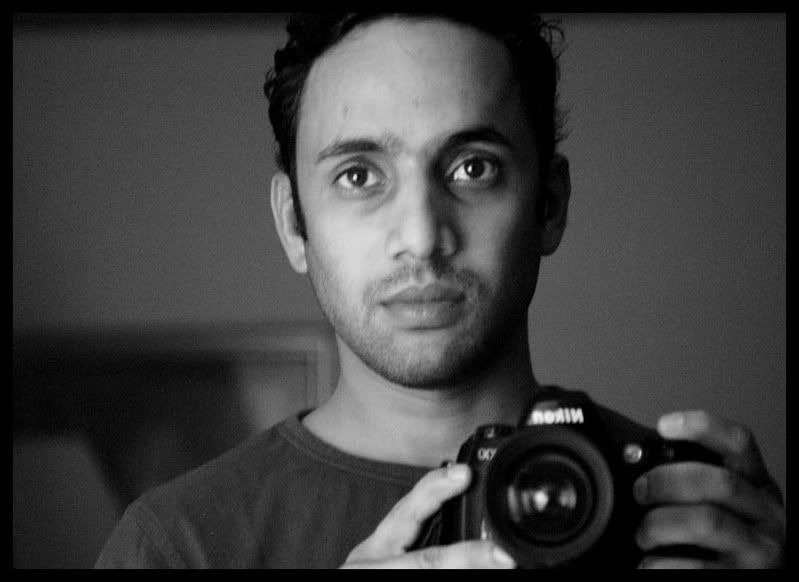
Ryan Lobo was one of the stars of TEDIndia, in my opinion. His presentation was not only spot-on point, but hauntingly beautiful and poignant. It was wonderful to come across someone so young and talented, and brave enough to go in a direction that his soul dictated. In the process he has collected a jewelled archive of stories; three of which he shared with the audience.

I've had the opportunity to interact since then with Ryan on a personal level; away from TED, in a more relaxed atmosphere, he indulged me in more stories over steaming cups of chai. I was moved by his earnest desire to do his job well, his commitment to authentic story-telling through multi-media, and most importantly by the person he is. Behind all his talent is an amazingly down-to-earth, accessible, yet deeply thoughtful human being.

Friday, June 19, 2009

Links I liked

Almost all my links today are TED related. This is not always the case, but there was too much good stuff:

1. Naturally 7, a group that could do an entire symphony using only voice, had us all rocking and jumping on our feet. You've GOT to check them out!

2. In the past few months, Nandan Nilekani (often referred to as the "Bill Gates of India") has been getting a bit overexposed; but his TED talk was actually quite good.

3. Stewart Brand's take on squatter cities and how they are the cities of the future.

4. Q&A session with one of my favorite photographers ever, Yann Arthus Bertrand.

Sunday, June 29, 2008

Pioneer Profile: Amy Smith

Amy Smith is the real deal. She shot to prominence in 2004, when she won the prestigious MacArthur Genius Award for her work in appropriate technology design.

Smith's greatest contributions, I believe, are in the world of education. An MIT student genius, Amy got her greatest technical challenges and lessons during her four-year Peace Corps assignment in Botswana. She brought her passion back to MIT and has since dedicated her life to educating and involving bright, young students in design for the poorest in the world. That is and will be her greatest legacy. D-Lab, her popular appropriate technology design class has spawned similar programs in other universities; and alums have gone on to spawn social innovation companies and/or become respected thinkers in their own right. What is greatest about her alums is that they have learned to consider the poorest person in the world when making any decision. They consider the impact their everyday decisions or technology designs have on those we least consider. Imagine what a different world this would be if every engineer, scientist, sociologist and politician considered and designed for the least of us all. Below, I've included Amy Smith's TED talk...where she talks about one of the appropriate technologies that have spawned out of D-Lab.


Resources:
http://en.wikipedia.org/wiki/Amy_B._Smith
http://mit.edu/mmadinot/www/home.html
http://www.ted.com/index.php/speakers/amy_smith.html
http://web.mit.edu/invent/a-winners/a-smith.html
http://mitworld.mit.edu/video/521/
http://www.iddsummit.org/
http://web.mit.edu/d-lab/#